Friday, February 6, 2015

Freak Friday

Cannibal Sativa


No. Enc.: 2d4 (2d4x10)
Alignment: Chaotic
Movement: 120' (40')
Armor Class: 6
Hit Dice: 4+20
Attacks: 1 (claw or weapon)
Damage: 1d4 or by weapon
Save: L2
Morale: 9
Hoard Class: I, VIII
XP: 540

These short, 3-4' tall, green-skinned humanoids are mutated from the Cannabis sativa plant. They have sharp, claw-like, five-fingered hands, and rope-like tendrils on their heads, shoulders, and backs. Because of their appearance and coloration, in forested or brush-filled areas, they are difficult to spot, surprising beings on a surprise check roll of 1-3 on 1d6. They are highly intelligent and have a spoken language and are also known as Cannibal Steves, Hemp Horrors, and (for the rarely encountered females) Murder Janes.

While Cannibal Sativas get along well with mutant fungus and plant species, they are obligate carnivores who form hunting parties to attack any animal life forms near their lairs. While they do ambush prey, they are also active hunters that prefer to directly attack their targets. They usually release a hallucinogenic gas cloud to disable their prey, and then they move in with their weapons for the kill. This gas cloud covers a 40' area around the Cannibal Sativa, and any creature (other than other Cannibal Sativas) in that area must make a save vs poison, or be subject to the effects of the hallucinogenic gas (roll 1d20 on the following table):
D20    Roll Reaction
1-2     Cower and whimper
3-4     Curl up into fetal ball
5-7     Stare into nothingness
8-10    Laugh uncontrollably
11-13   Overcome with insatiable hunger and thirst
14-16   Falls asleep
17-18   Flee shrieking in a random direction
19-20   Hallucinates as if under the effect of Mental Phantasm
While they can and do employ ranged or missile weapons in attacks, they have a preference for sword-like and axe-like weaponry. Roll 1d4 to determine their individual armament: 1 - Club, 2 - Axe, 3 - Short Sword, 4 - Pistol (Roll 1d6: 1 - Black Powder, 2 - Revolver, 3 - Automatic Pistol, 4 - Machine Pistol (as SMG), 5 - Stun Pistol, 6 - Laser Pistol).

Cannibal Sativas can generally be found lairing in ruins or caves in forested or swampy regions.

Mutations: Carnivore, Free Movement, Full Senses, Toxic Weapon

Friday, January 30, 2015

Freak Friday

Osseous Walker


No. Enc.: 3d4 (3d10)
Alignment: Chaotic
Movement: 60' (20')
Armor Class: 7
Hit Dice: 1
Attacks: 1 (fist or weapon)
Damage: 1d6 or weapon
Save: L1
Morale: 12
Hoard Class: None
XP: 10

Osseous Walkers are the skeletal remnants of those Ancients who have been subjected to nanomachine bone grafts. They appear as human-sized silvery-grey bones arrayed like an anatomical model skeleton. While not capable of advanced reasoning, the nanomachines are able to use their skeletal form to utilize weapons in a club-like fashion.

These nanomachines have very limited programming and only seek to support the bone structure they are grafted onto. In order to support bone tissue, they seek living creatures for the biological nutrients contained in living bodies, though they do not masticate them. In order to transfer the nutrients needed, the nanomachines need to place the bones in direct contact with immobilized creatures. Immobilization is best done through killing the creature, though the nutrient material needed only remains viable in the first day or so.

Osseous Walkers generally lair in ruins or underground, where they can safely remain in contact with their nutrient "baths" with little disruption. Those found actually walking will do so because the nanomachines have detected new sources of nutrients for the bones they support. As there is no biological intelligence to be found in Osseous Walkers, they are unaffected by mental mutations which affect the mind. Mental mutations capable of linking with computers/robots will only sense the basic desire of the nanomachines to find sources of nutrients for the bones.

Mutations: None

Friday, January 23, 2015

Freak Friday

Carrion Mangrove


No. Enc.: 1 (1d4)
Alignment: Neutral
Movement: None
Armor Class: 3
Hit Dice: 12
Attacks: see below
Damage: see below
Save: L6
Morale: None
Hoard Class: XIX (x2)
XP: 2000

Carrion Mangroves are immobile, mutated Avicennia germinans which appear among, and nearly identical to their unmutated versions. Appearing as a 40'-60' tall mangrove tree with dark brown bark, elliptical, dark green leaves, and small creamy white flowers, their distinguishing feature is their long, underground system of roots and hundreds of pencil-like pneumatophores which grow upwards from the roots, appearing as a field of stakes. Decaying corpses may be noticed among the root system on a roll of 1-3 on 1d6.

This mutant tree doesn't actively hunt, but rather depends on its root system to deal with prey. Each Carrion Mangrove's root system covers a 100' diameter area around the tree. When prey is detected through ground vibrations, the nearest pneumatophores (roll 2D10 to determine number) shoot small poisonous thorns straight up into the prey doing 1d4 damage each. Each thorn has a Class 11 poison which causes paralysis for 2d6 rounds for each thorn which strikes the target. Victims that are paralyzed tend to fall directly onto 2d4 pneumatophores, causing 1d6 damage for each one struck, additionally, each pneumatophore pumps out the same Class 11 poison each round. Since these victims generally can't save against so many poison sources, they tend to be paralyzed until death from thirst or drowning. Carrion Mangroves feed on the blood and decaying bodies thus created.

These trees can be found just above the high tide line in the sandy or muddy regions around brackish water estuaries, lagoons, and mangrove swamps.

Mutations: Modified Vines and Roots (CotTW)


Hangman's Tree


No. Enc.: 1 (0)
Alignment: Chaotic
Movement: None
Armor Class: 3
Hit Dice: 9
Attacks: 4 (constrictive tendrils)
Damage: 2d6
Save: L5
Morale: None
Hoard Class: XIX
XP: 1700

This tree is a mutated version of Carya texana appearing as a hickory tree 20-30' tall with dark grey bark covering a trunk roughly one foot in diameter, shiny, dark green leaves which turn golden-yellow in autumn, bronze-colored nuts, and yellow catkins.

Hangman's Trees attack by dropping 1d4 constrictive tendrils around prey. A successful attack roll achieves constriction, and the victim will suffer 2d6 damage on each consecutive round. The length of these tendrils ranges from 10’ to 20’.

They are typically found in hilly, forested regions. Their fruit is edible and considered tasty (see New Mutation - Edible Leaves)

Mutations: Prehensile Tendrils, Edible Fruit


Hellions


No. Enc.: 0 (2d10)
Alignment: Neutral
Movement: None
Armor Class: 7
Hit Dice: 4
Attacks: 1
Damage: 4d6
Save: L2
Morale: None
Hoard Class: None
XP: 290

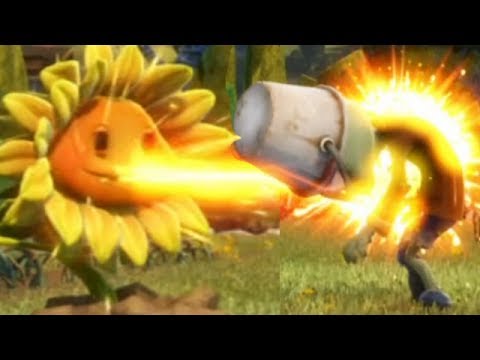
Hellions are mutant Helianthus annuus (sunflowers) that were failed bio-correcting solar collection plants, reflecting powerful beams of sunlight against nearby terrain as they track the sun across the sky. They appear as typical 10' tall sunflowers whose flowers actually track the sun's path across the sky. At frequent intervals (once every three rounds) during sunny days, they emit their stored solar energy at a spot up to 50' away. Often this results in only scorched ground, and the areas around Hellion fields are often scorched of vegetation making them easy to recognize. If any creature wanders into the area however, there is a chance that they may be struck by a beam (roll to attack any targets in the area with a -2 to the attack roll).

Mutations: Glow in the Dark (CoTW), Reflective Epidermis (Heat), Reflective Epidermis (Radiations), Thermal Emissions (Heat)

Friday, January 16, 2015

Freak Friday

Carnifolia


No. Enc.: 1 (0)
Alignment: Neutral
Movement: None
Armor Class: 2
Hit Dice: 10
Attacks: see below
Damage: see below
Save: L5
Morale: None
Hoard Class: XX
XP: 3800

These mutated, unintelligent Taxus brevifolia appear as 50' tall evergreen trees which have apparently rotted from the inside, creating hollow cavities which appear to be inviting places to shelter. With their brown, scaly bark, dark green, lanceolate leaves, and bright red, berry-like seed cones, these carnivorous predators are almost impossible to distinguish from normal trees. There is only a 1 in 6 chance that a creature will recognize a Carnifolia as such, although plant mutants can detect them on a 3 in 6 chance.

Carnifolia have two primary means of enticing creatures to rest within their tempting cavities. If any creature consumes the red seeds of the plant, they must make a saving throw vs poison or feel compelled to stop and rest within the cavity. Of course if the weather is inclement, the hollow cavity may also appear as an inviting place within which to shelter. Any creature which falls asleep within the hollow cavity will cause the cavity to close and begin filling with a digestive sap which oozes up from the roots, at a rate of one foot per round until the 10' cavity is filled. The digestive sap does 1d8 damage per round until the creature dies. The limited room inside the cavity prevents those trapped inside from attacking by any weapon except a dagger. Additionally, attacking from within the cavity is difficult, and the attack suffers a -4 penalty.

These tree predators can be found just about anywhere, although they will only be found near streams in drier regions.

Mutations: Carnivore, Edible Seeds (CotW), Energy Absorption (Electricity; CotW), Thermal Sensitivity (Fire)

Friday, January 9, 2015

Freak Friday

Baneboo


No. Enc.: 1d4 (1d4)
Alignment: Neutral
Movement: 90' (30')
          Fly: 240' (80')
Armor Class: 5
Hit Dice: 5+5
Attacks: 2 (bite or mutation, constrict)
Damage: 6d6/2d
Save: L3
Morale: 10
Hoard Class: XV
XP: 1460

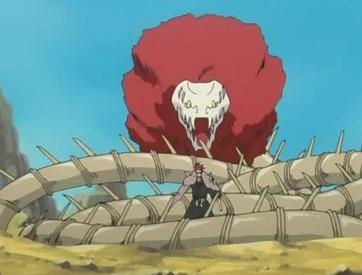
Designed as a bio-weapon by a certain demented bio-lab, best left forgotten, this strain of Phyllostachys rubromarginata has been turned into a ferocious predator. They appear as bamboo-like serpents some 30' long with a fanged, skull-like head and red ruff or mane. They fly by means of four delicate, leaf-like wings that contained under a protective layer of bark which acts similar to an insect's elytra. Primarily meat eaters, they generally prey on large game animals, but have been known to attack larger prey or humanoids. Additionally they are known to consume certain amounts of metal for unknown reasons.

Baneboo typically attack as if they were Giant Pythons, starting with a bite, and following up on a successful hit with a constricting attack that does an additional 2d4 hit points of damage. This constriction attack continues on ensuing rounds. When cornered, surprised, or seriously wounded, Baneboo are capable of spitting a poisonous gob up to 60' away. This gob is a Class 16 poison that causes death to targets unless a successful save vs poison is made, then the character takes 5d6 damage. Baneboo can spit a poisonous gob up to 3 times per day.

Habitually sheltering in caves or ruins found among wooded or forested areas, Baneboo are known to collect metallic objects and other valuables which they obtain by scouring ruins.

Mutations: Carnivore, Complete Wing Development (Elytra - see Wisdom from the Wastelands #40), Free Movement, Full Senses, Metallic Bark (see Creatures of the Wastes), Toxic Weapon

Monday, January 5, 2015

Mutant Monday

Well, the holiday season is finally over, and I've gotten the problem with my ISP fixed. However, Mutant Monday will be moving to Freak Friday for the next six months or so. Hopefully I'll also be getting some of my other little ideas worked out and projects done.

Saturday, January 3, 2015

MUTANT: Year Zero Review

For this review, I'll be covering Modiphius Entertainment's MUTANT: Year Zero - Roleplaying At The End Of Days (English translated version of Paradox Entertainment AB's game). Unlike some of my other entries, I'll be covering the mechanics and layout of this offering a bit more than I normally would, since the overall mechanics really tie in to how the game is played.

Likes (D6):
  • 1. The artwork is well done, with the inclusion of both color and B&W art which supports the setting appropriately, and appears often enough to augment the text without generally bogging it down. I'll even go as far as to agree with the use of a standard two-column layout of text (in general, with exceptions for utility, like tables and the "Index").
  • 2. Character creation is quick and easy. The inclusion of character classes (called "Roles") with skills (though I wasn't too keen on the limited class skills). Example names, though limited, are included, though probably scattered too much throughout the book for quick reference.
  • 3. The mechanics do provide a gritty, post-apocalyptic feel, while retaining a good mix of gonzo elements. The Rot as a generic mechanic for CBR hazards was fairly well implemented, though I thought it's generic nature lost some points because detection devices (such as chem sniffers or geiger counters) were missing. While food, clean water, and ammo were stressed as resources to help give that scavenger/survival feel, fuel sources (especially for vehicles) seemed a bit more hand-waved to the detriment of the setting.
  • 4. The setup that allows and encourages building up the PCs home base "Ark." When combined with the (somewhat flaky, see below) Artifact system, it makes for an interesting challenge.
  • 5. There are some rules for scavenged arms, armor and equipment, though I'd probably only rate the system as fair, due to the quick-play mechanics of the system.
  • 6. A fairly good setting, with sample locations, ideas for other locations, and factions to interact with.

Dislikes (D66):
  • 11. Useless 'Chapter Only' "Table of Contents" (sorry, if your TOC only shows what page a chapter is on, it's f***ing useless as a TOC for a Role Playing Game). While I don't mind the small image included with each chapter, spreading this useless POS over FOUR pages (two PC section and two GM section) was a waste of space (though no doubt makes sense from a designer's perspective (i.e. holding a physical book let's you see the whole PC or GM section at one glance). Also the PDF version didn't even hyperlink the chapters.
  • 12. Character sheet in the "middle" of the book (pages 20-21). With the TOC being useless, having this in the middle of the book just makes it difficult to find. Moreso when the 'Index' has this for the Character Sheet entry, "Character Sheets 11, 265". On page 11 is the mention of Character Sheets as s tool of the game (oddly saying you can find one at the back of the book, which would be page 265, except, it's not there, instead some art and quote page is there.
  • 13. Actually, somewhat of a personal dislike here, I'm not fond of a lot of the "two-page" layouts for the material in this book, while it works somewhat for a physical book, all it does in PDF form is highlight wasted space (or artificial page count padding...see Seclusium of Orphone of the Three Visions for an extreme example of this). The "color" page borders with what appears to be fairly extreme text margins doesn't help either.
  • 14. Quick character creation because there's really only one offering of character type; Mutant Human. Pure Humans, Animal Mutants, Plant Mutants, Robots, Cyborgs, and the like are hinted at, and appear as NPC monster types, but with so little information as to be only a teasing appetizer.
  • 15. The lack of gonzo mutations for mutants. There's only 24 mutations available, the game recommends that each PC have a different one, and then half fills a D66 table* for random rolls.
  • 16. Really poor overall layout in that you're constantly told to reference some other part(s) of the book for information on most subjects. (When you're not being teased with "be covered in future supplement" tidbits.)
  • 21. A "unique sector generation system" that has the most useless table in the entire book. It can be summed up thusly, "ruin environments have ruins and artifacts, wilderness environments don't; all environments have threats". For that I needed a whole table taking up a quarter of a page? Admittedly, the rest of the material in the chapter is quite useful, to the point you may want to incorporate much of the material into your own game.
  • 22. *I have to qualify this dislike a bit. While I'm not opposed to limiting the mechanics resolution to use of one or more D6s on its own merits (easy availability of dice with which to play the game), I am opposed when the only reason for really doing so is so you can sell your own, custom (and overpriced) dice. Even using D6 based tables though, the table layouts in this book are much better than Barbarians of the Aftermath, though still not great because of their limitations (i.e. 24 mutations on a D66 table).
  • 23. I'm not completely sold on the way "Artifacts" are done in this system. Certainly it makes sense with the way the game is laid out, however some of the choices don't really seem to fit (I'll admit, this reaction may mainly stem from being presented with the first "Artifact," "Air Mattress," I mean, seriously, an air mattress, doesn't quite fit the whole gritty PA feel the designers have been trying to interject).
  • 24. The price tag, twice the price of The Mutant Epoch, maybe one quarter of the utility. Combined with constant references to the custom dice and cards for the game (overpriced merchandizing), you feel like you paid way too much for way too little.
  • 25-66. Re-roll

Overall, I felt that this game was more of an overdeveloped board game or underdeveloped computer RPG than a table top, pen-and-paper RPG. There are a few useful things to take a look at in the setting, and the game mechanics are intriguing enough for representing a grim and gritty PA feel, but for the price, you're better off looking elsewhere. Maybe in the future if the expansion material gets published and can be incorporated into one book for a reasonable price, this might be something to use as a go-to Post Apocalyptic RPG, but for now, not really.


Edit: After thinking about it a bit, I've decided that this "game" is more like a large adventure module of the sandbox-setting style rather than a board game or CRPG. It is great for running a limited sandbox, but as it's own RPG it still doesn't make the grade.

Monday, December 15, 2014

Mutant Monday

This will be a bit stranger than my normal selection for Mutant Mondays. Today, I want to talk about a certain type of creature not usually seen in RPGs, the Animal Eye Spy/Messenger. These creatures generally appear in various works of fiction, such as the Crebain of Lord of the Rings, Gwythaints from the Chronicles of Prydain, crystal eye bats from The Dark Crystal, various corvid species in general, etc. I'm not really talking about wizard & witch familiars that can be used for spying or carrying messages, or any sort of power that lets a person see through an animal's eyes or control animals, but rather, species of creatures that have the ability to search out their master's foes and carry messages, like the examples listed.

Seeing the lack of such creatures, I thought I'd stat up a few, though they're generally geared more toward traditional fantasy than post apocalyptic settings.

Crimson Crow

No. Enc.: 4d4 (4d4)
Alignment: Chaotic
Movement:
          Fly: 270' (90')
Armor Class: 6
Hit Dice: 2+4
Attacks: 1 (eye peck or claw)
Damage: 1d2/1d4
Save: L1
Morale: 8
Hoard Class: VI
XP: 59

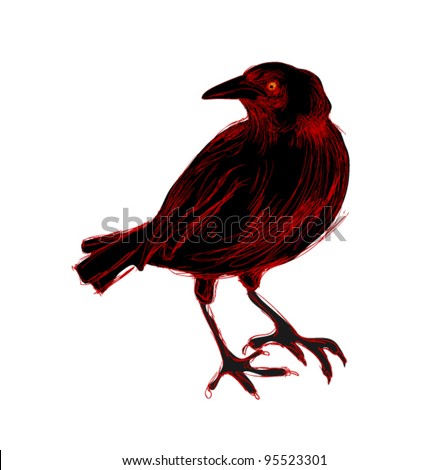
Crimson Crows are large, crows of a dark red color, typically 3 feet long with wingspans of about 5½ feet. They primarily feed on small animals, specifically rodents, rabbits and hares, small swine, various procyonids, and mustelids. They will also feed on the carcasses of any larger creatures that they encounter, though they rarely attack anything more than 1½ their size.

These disreputable creatures are known to serve powerful Chaotic aligned creatures as spies and informants, trading their services for meat and shiny gee-gaws which they hoard in their nests. While they have excellent vision, equal to an eagle's eyesight, they also have decent nightvision and ultraviolet vision. They are also able to communicate intelligently, with a vocabulary of several hundred words.

Mutations: Increased Vision, Bizarre Appearance


Night Raven


No. Enc.: 1d6 (2d4)
Alignment: Chaotic
Movement:
          Fly: 180' (60')
Armor Class: 5
Hit Dice: 3+3
Attacks: 2 (2 claws or bite)
Damage: 1d6/1d6/2d4
Save: L2
Morale: 9
Hoard Class: II (x3)
XP: 205

These huge, sleek predators appear as dark blue-black crows about 6' long with wingspans of 10-12 feet. Night Ravens are evil and known to serve as scouts and spies for any Chaotic being that can meet their price, 30 pieces of silver per job, with very specific contractual requirements, communicated through Neural Telepathy.

As they are nearly man-sized, they are known to prey extensively on humanoids, though only those they outnumber at least three to one, or who appear weakened, diseased, wounded and unarmed and easy prey. Uninterested in corpses and other animals, they prefer only live prey.

While they have excellent Nightvision, they primarily hunt prey with their mental abilities; Empathy and Track Mind (Creatures of the Wasteland) to locate targets, and Neural Telepathy to extract information.

Mutations: Gigantism, Empathy, Track Mind (CotW), Neural Telepathy


Dire Corbie

No. Enc.: 1 (1d4)
Alignment: Chaotic
Movement:
          Fly: 120' (40')
Armor Class: 4
Hit Dice: 4+2
Attacks: 3 (3 claws)
Damage: 2d4/2d4/2d5
Save: L3
Morale: 10
Hoard Class: XIX
XP: 245

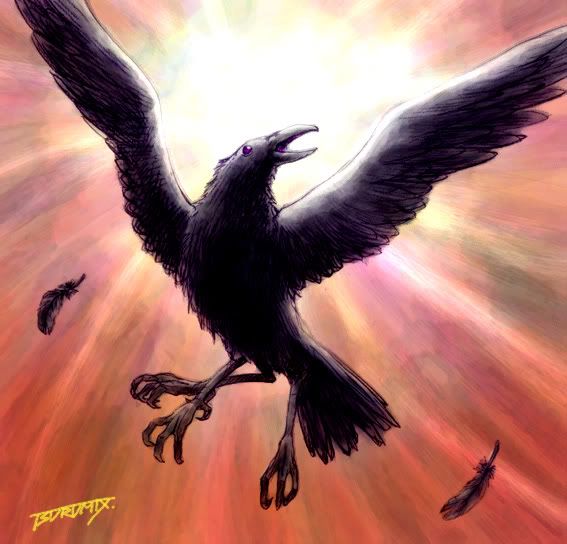
Dire Corbies are immense, 8 foot long, three-legged crow-like creatures with a wingspan of 15-16 feet. While not quite large enough to be used as mounts by average-sized humanoids, they are occasionally known to carry small humanoids or creatures, though they will never act as steeds, instead, carrying the creature in their claws. These rare creatures will be found employed by only the most powerful Chaotic aligned villains, as the price of their service is often very high, typically multiple artifacts (magic items).

Thorough carnivores, they will attack just about any creature that they could possibly consume. Generally they attack by sinking all three claws into a victim in a swoop attack, and if they successfully connect, lifting the target into the air, to drop them from a considerable height.

Dire Corbies gather information with their powerful sight, increased range of vision, nightvision, ultraviolet vision, thermal vision, and 360 degree vision, allowing them to visually observe just about any target within miles of their location.

Mutations: Increased Sight, Thermal Vision, 360-Degree Vision (Creatures of the Wastes)


Spyder


No. Enc.: 1d8 (1)
Alignment: Chaotic
Movement: 120' (40')
          Web: 120' (40')
Armor Class: 6
Hit Dice: 2+2
Attacks: 1 (bite)
Damage: 1d6, poison
Save: L1
Morale: 7
Hoard Class: VI
XP:

Spyders are a mutated breed of giant hunting spider with a single large eye that can transmit its images to a selected recipient. Generally, dark grey to black in color, these 1' long spiders are hairy and of a fairly placid disposition. Unlike many other types of spiders, Spyders do not spin webs, although they can negotiate webbing, vertical surfaces, and even cling to ceilings.

While primarily passive observers, Spyders can attack humanoids, usually by leaping at their target to bite. They can leap up to 40', allowing them to cross large gaps, attack prey, or flee. Their venom contains a Class 12 poison.

When not being actively used to spy for their masters, they lair in large, dark caves and ruins, avoiding light, though they are not nocturnal or even light-blind.

Mutations: Gigantism, Increased Vision, Reverse Clairvoyance (NEW)


Eye Bat

No. Enc.: 1d6 (3d6)
Alignment: Chaotic
Movement:
          Fly: 240' (80')
Armor Class: 7
Hit Dice: 2
Attacks: 2 (2 claws)
Damage: 1d2/1d2
Save: L1
Morale: 7
Hoard Class: None
XP: 47

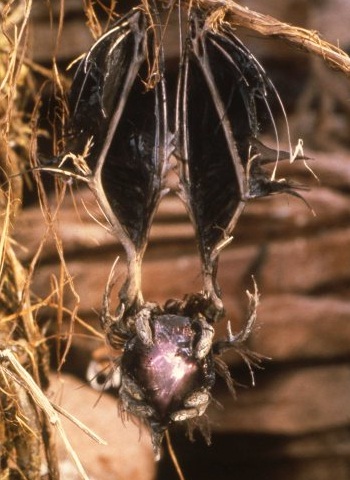
Eye Bats are large grey-brown, bat-like creatures with a wingspan of 4-6 feet, and a large, single eye in place of a head. Employed by intelligent Chaotic beings of all stripes, they are used as ocular scouts to find targets for their masters. Generally unintelligent, they must be telepathically guided to their target(s). Oddly, since they have no known mouthparts, it is unknown what they consume, or even if they eat at all.

Their masters rarely use Eye Bats for combat, attacking only as a last resort (although a few villains are known to habitually sacrifice Eye Bats as one-shot kamikaze weapons against their foes).

It is not known how Eye Bats are produced (or reproduce, if they do so), however, with their acute vision and mental capabilities, they do make excellent spies.

Mutations: Bizarre Appearance, Reverse Clairvoyance (NEW), Mental Slave Bond (NEW)


Wyrmpire


No. Enc.: 2d4 (2d4)
Alignment: Chaotic
Movement: 60' (20')
          Fly: 180' (60')
Armor Class: 5
Hit Dice: 3
Attacks: 3 (2 claws, bite)
Damage: 1d4/1d4/1d6
Save: L1
Morale: 9
Hoard Class: None
XP: 95

Wyrmpires are flying bird-lizard creatures with grey skin and black wings. Though small (about 2 feet long with a wingspan of 3 feet), they can be fairly dangerous, as they are known to be blood drinkers. Somewhat intelligent, these creatures are sometimes employed by Chaotic masters as spies and scouts. However, they have only a limited ability to communicate, generally a vocabulary of 100 or so words.

These creatures will attack just about any mammal, humanoid or otherwise, but only if the creature is small enough to physically overpower, or somehow restrained, incapacitated, paralyzed, asleep, or otherwise immobile. When attacking a target, they prefer to grip with both claws and then physically biting their victim in order to drain blood (1d6 damage per round that they are in contact with the victim).

Mutations: Bizarre Appearance, Complete Wing Development, Dietary Requirement Change (Blood, see Creatures of the Tropical Wastes)


New Mutations
Reverse Clairvoyance (Beneficial Mental Mutation)
This mutant can transmit visual images to a selected recipient up to 100’ away, allowing the recipient to see as if they were standing on that spot.

Mental Slave Bond (Mental Drawback Mutation)
This power functions as if the mutant is under the effects of the Possession mutation, with some differences. Unlike Possession, the creature in control is not directly controlling the victim, but rather issuing mental commands which must be obeyed (Mental Combat with a -4 to WIL for a mutant with the Mental Slave Bond to resist the command). Neither is the controller directly receiving sensory information from the mental slave, instead they must concentrate to receive information and/or pass on mental commands. If the controller is concentrating on the linkage to the mental slave, and that mental slave is killed, the controller must save vs stun attacks or be rendered unconscious for 1d6 hours.

Monday, December 8, 2014

Mutant Monday

Ash Dragon


No. Enc.: 1d6 (2d6)
Alignment: Chaotic
Movement: 90' (30')
Armor Class: 6
Hit Dice: 3+3
Attacks: 3 or 1 (2 claws, 1 bite, or breath)
Damage: 1d6/1d6/1d8 or 2d10
Save: L2
Morale: 10
Hoard Class: None
XP: 310

Mutated Morchella tomentosa that have become 2' long lizard-like creatures with ashen scales. These creatures abide near existing bodies of fire, among the ashes left.

While their primary diet is the ashes left by any burning conflagration, they can also consume meat from any animal. They prefer to attack any unwary visitors to their habitats by breathing their flame breath (2d10 damage up to 50') and then clawing or biting those that survive.

Ash Dragons are commonly found in ruins where fires have occurred, battlefields with burning wreckage, forests that have had recent forest fires, volcanic areas, and occasionally wasteland or desert regions.

Mutations: Reflective Epidermis (Heat), Energy Ray (Fire), Free Movement, Full Senses, Dietary Requirement Change (Ash) see CotTW, Thermal Sensitivity (Cold)

Monday, December 1, 2014

Mutant Monday

Arkansas Barking Spider


No. Enc.: 1d6 (1d6)
Alignment: Neutral
Movement: 60' (20')
          Web: 120' (40')
Armor Class: 6
Hit Dice: 3+3
Attacks: 1 (bite)
Damage: 2d4, poison
Save: L2
Morale: 7
Hoard Class: VI
XP: 205

The Arkansas Barking Spider, a mutated species of Steatoda nobilis, is a 3' long spider with a dark brown globular abdomen with white markings in the shape of a skull and reddish-orange legs. They are web-spinning spiders that construct strong, sticky tangle webs (also known as cobwebs) in order to trap prey. Because they are web-spinning spiders, they have poor eyesight and use their vibration sense to locate prey and potential predators.

While Arkansas Barking Spiders are generally uninterested in humanoids and large creatures, preying primarily on small mammals and smaller mobile plants, they do employ a notable preemptive defensive measure when man-sized or larger creatures near their webs, by emitting a special gas cloud in a 30 foot radius which lasts for 1d3+6 turns in still conditions and 1d3+1 turns in windy conditions. Each round a target is in this gas cloud, the character must save vs poison or spend 1d4 rounds doing nothing but gagging, vomiting, and retching, and trying to get away from the silent but deadly gas. Any character that has failed the saving throw also suffers an AC penalty of 1 and +2 to all attack rolls. A gas mask or other filtering device will protect against this gas attack. For predators that persist in approaching the web, the barking spider will begin to a vocal warning consisting of their characteristic "barking."
For those foolish enough to actually get trapped by the web, they can break free in 2D4 turns, unless their strength is 19 or greater, in which case, they can break free in 2d4 rounds. For each round someone is stuck in the web, they will be attacked by half the number of Arkansas Barking Spiders that are present. For each bite, the victim may make a save vs poison against a class 6 poison.

Arkansas Barking Spiders typically make their huge (20-50' in diameter) cobwebs in caves or forests, hiding any treasures they accumulate in small holes.

Mutations: Toxic Weapon, Unique Sense (Vibration Sense, see Creatures of the Tropical Wastes), Webbing (WftW #7), Vision Impairment