Showing posts with label New Mutation. Show all posts

Tuesday, January 10, 2017

Sea Savages

DEEP DIVER


No. Enc.: 1d6 (3d10)
Alignment: Neutral
Movement: 60' (20')
          Swim: 90’ (30’)
Armor Class: 5
Hit Dice: 2
Attacks: 1
Damage: 1d6 or weapon type
Save: L1
Morale: 9
Hoard Class: XXII
XP: 20+

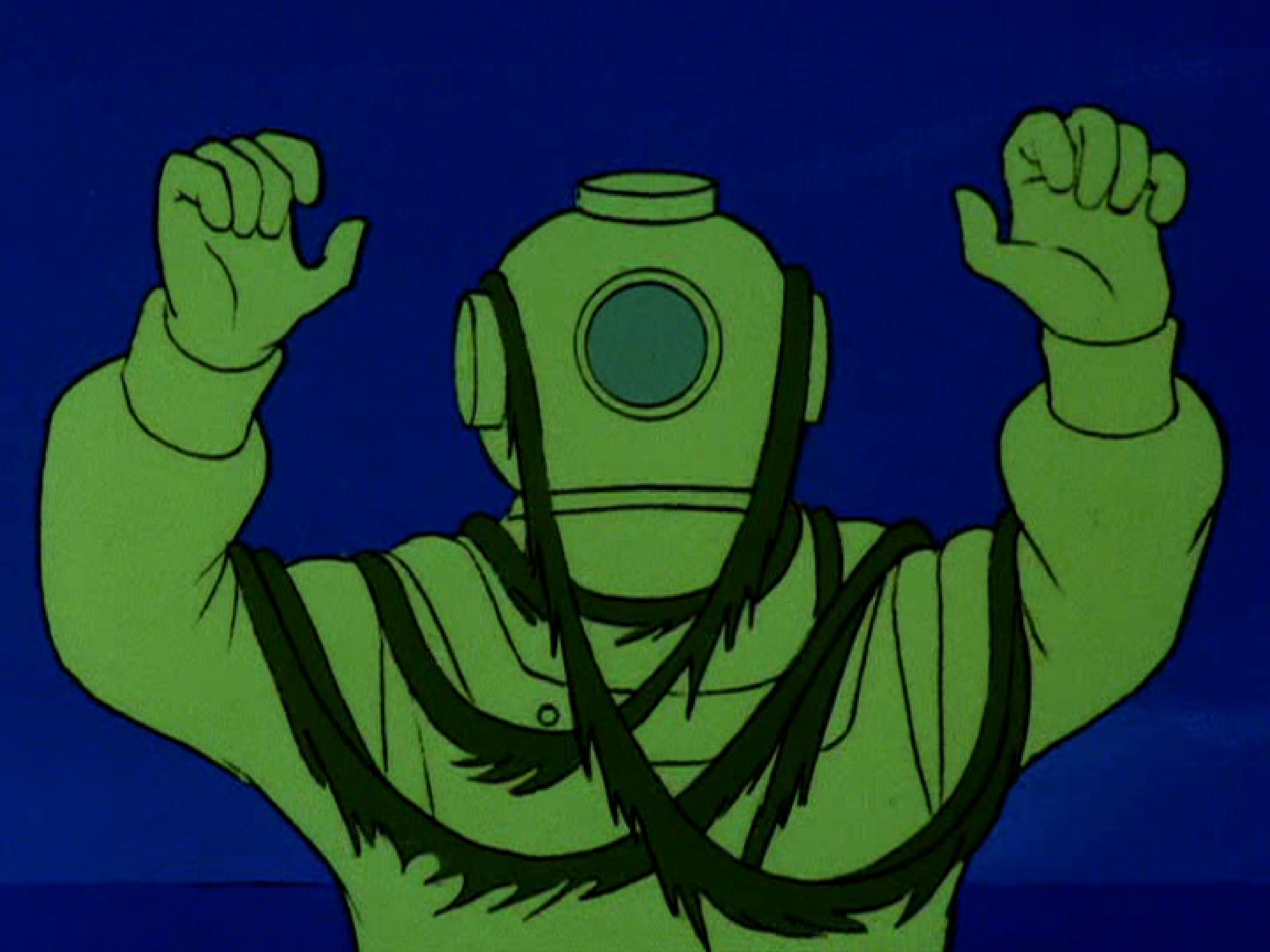
These creatures are the often mutated descendants of the inhabitants of underwater dome cities, military bases, modular habitations, and research stations. They appear as metal-headed humanoids, with dark, rough looking skin, often covered in algae, kelp, barnacles, limpets, mussels, sea stars, seaweed, and sargassum. Deep Divers may be found in and around seas and oceans, rarely venturing too far inland. Fishmen, Giant Octopi, Giant Squid, and monstrous sharks are their natural enemies.


While generally not a threat to land dwelling creatures, they are occasionally found in small hunting or salvage parties which may attack other creatures for food or salvageable material. They are typically armed with a knife and one other weapon. Roll 1d12 to determine what other weapon they have: 1 - Underwater Pistol, 2 - Axe, 3 - Pry Bar, 4 - Grappling Hook, 5 - Harpoon, 6 - Speargun , 7 - Hawaiian Sling, 8 - Trident, 9 - Harpoon Gun, 10 - Polespear, 11 - Powerhead, 12 - Underwater Assault Rifle.

Mutations: 50% chance of mutations, roll 1d6 times on Mutation Table below.


FROGMAN

No. Enc.: 1d6 (1d6x10)
Alignment: Varies, see below
Movement: 90' (30')
          Swim: 120' (40')
Armor Class: 8
Hit Dice: 1+2
Attacks: 1
Damage: 1d6 or weapon type
Save: L1
Morale: 8
Hoard Class: XXII
XP: 10+

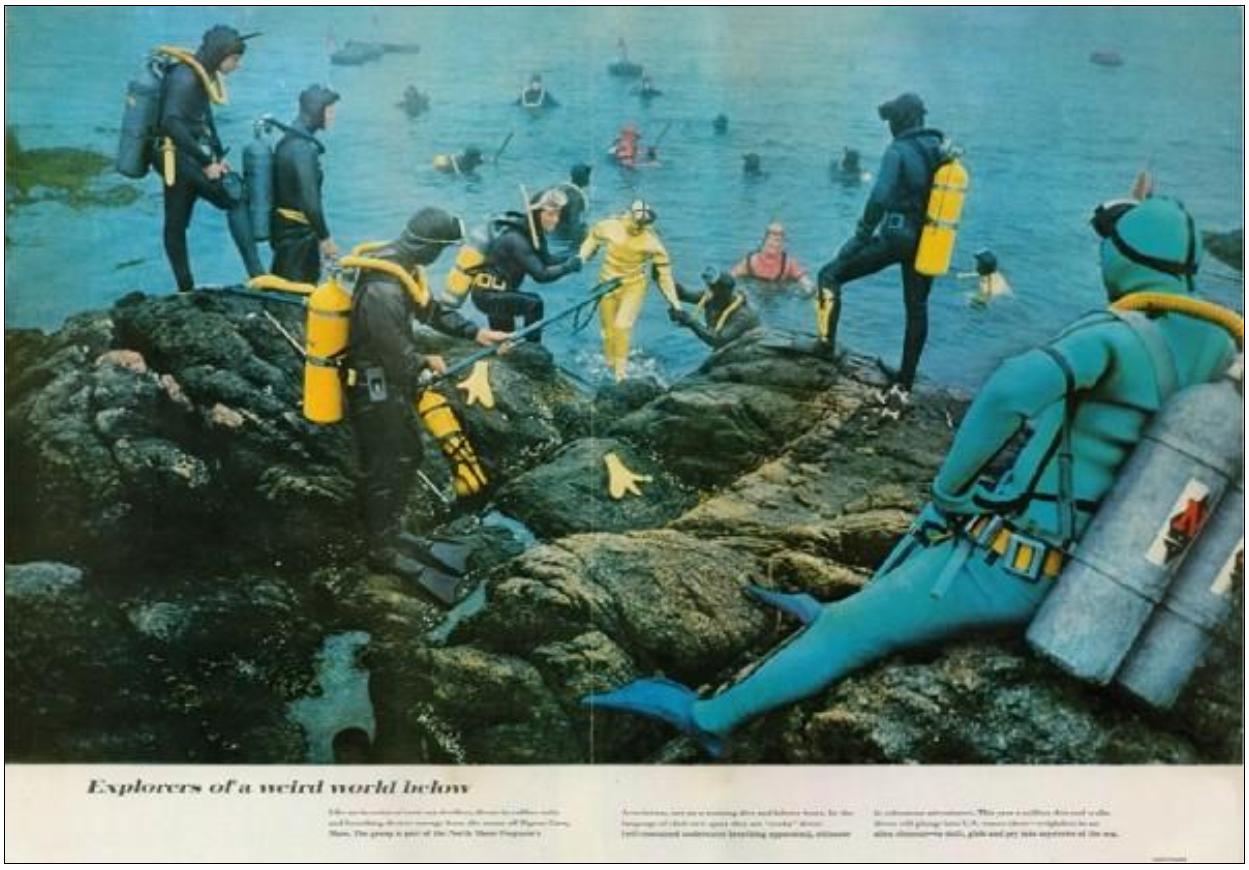
Frogmen are mutant humanoids who primarily live in underwater communities. While generally similar in appearance, with long, flippered feet, large monocular eyes, and strange mouths connected by tube-like growths to large tanks or canisters on their backs or chests, there are many different tribes of Frogmen. Tribes of Frogmen can be identified by their coloration, known coloration includes (alignment in parantheses); black & grey (N), black & red (C), black & yellow (C), black (N), blue & yellow (L), blue (L), dark green (N), grey (C), light green (C), orange (L), pink (L), red & gray (C), red (C), silver (N), and yellow (N). Generally encountered in coastal areas, they can sometimes be found near lakes and large rivers. Pirates, Fishmen, Sharks, and Sea Snakes are their natural enemies.
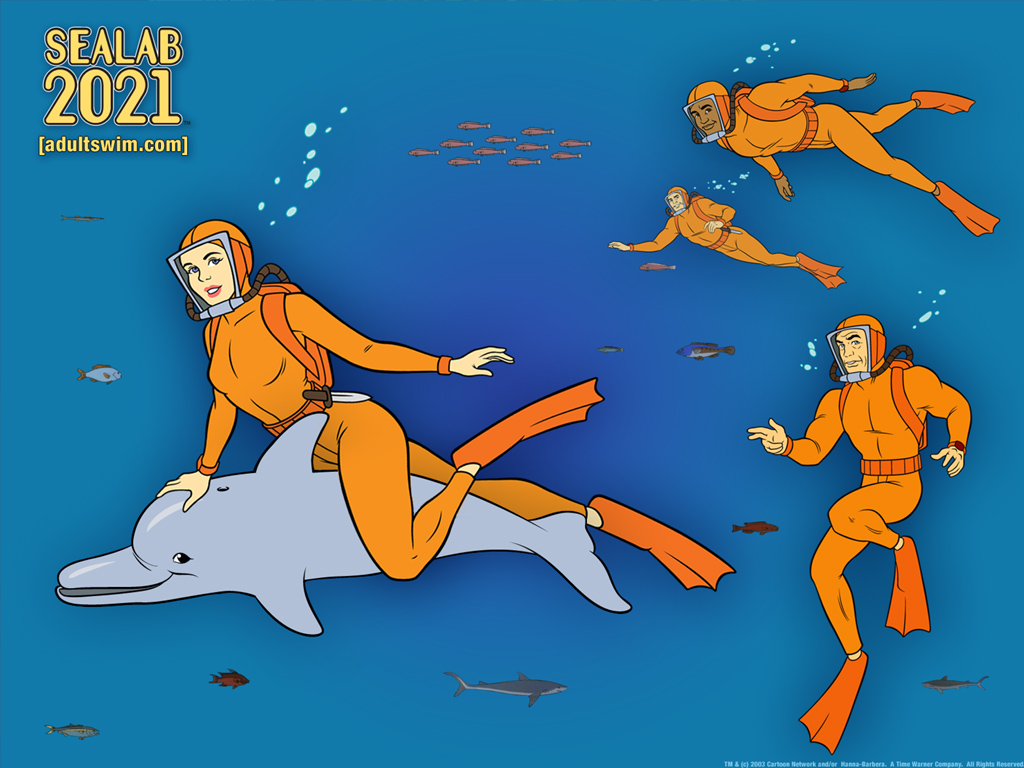


Groups of Frogmen encountered will generally be of the same tribe. All will be armed with a knife and may have another weapon present (50% chance). Roll 1d12 to determine what other weapon they may have: 1 - Underwater Pistol, 2 - Boarding Axe, 3 - Cutlass, 4 - Grappling Hook, 5 - Harpoon, 6 -Speargun , 7 - Hawaiian Sling, 8 - Trident, 9 - Harpoon Gun, 10 - Polespear, 11 - Powerhead, 12 - Underwater Assault Rifle.

Mutations: 33% chance of mutations, roll 1d4 times on Mutation Table below.


MUTATION TABLE
Roll Mutation Roll Mutation
1 Amphibious (NEW) 7 Ink Spray (NEW)
2 Bioluminescence (NEW) 8 Nightvision
3 Body Dehydration (NEW) 9 Slow Mutant
4 Echolocation 10 Swimming Fins (NEW)
5 Gills (NEW) 11 Vision Impairment
6 Increased Caloric Needs 12 Webbed Hands & Feet (NEW)

NEW MUTATIONS

Amphibious (New; Beneficial Physical Mutation)
A character with this mutation can breathe freely in air or water, but suffers from the need to drink twice as much liquid as normal or risk dehydration.

Bioluminescence (New; Beneficial Physical Mutation)
Creatures with this ability can cause their body, a special organ, or parts of their body to emit light. Roll 1d8 to determine color: 1 - Violet, 2 - Yellow, 3-4 - Green, 5-6 - Blue, 7 - Orange, 8 - Red. Roll 1d6 to determine specific ability:
1. Bioluminescent Cloud Spray. Similar to the ink spray mutation, except this ability sprays out a cloud of bioluminescent particles, which has a similar effect underwater. It reduces visibility and smell to zero for up to 10 minutes in a 20' radius. However, it can only be used once per day due to the high metabolic costs of producing the bioluminescent particles.
2. Bioluminescent Blinding Pattern. Another advanced form of the bioluminescence, which allows the creature to modulate and pulse the bioluminescent photophores in a pattern designed to blind the target creature. The effects and saving throw are the same as Nonlethal Photon Grenade. 3. Bioluminescent Lure. This mutation generates a dangling appendage which glows, making the mutant appear to be another, smaller, creature. Smaller creatures, upon which the mutant feeds, are attracted to the patch, mistaking it for food. Make a saving throw vs stun for creatures to determine if they make this mistake and move closer to the mutant.
4. Whole Body Bioluminescence. The entire body glows, illuminating a 30' radius area. This light will not emit heat, and does not interfere with infravision etc. If the mutant loses consciousness while using this ability, the glow will rapidly fail.
5. Bioluminescent Distraction Pattern. This advanced form of bioluminescence allows the creature to further distract the predator or prey by modulating or pulsing the bioluminescent producing organs in a distracting pattern. Make a saving throw vs stun, failure means a -2 to the victim's to hit rolls.
6. Bioluminescent Hypnosis. The most advanced form of bioluminescent defense, wherein the luminescent patches or photophores are pulsed in a hypnotic pattern. The effects and saving throw are identical to Fragrance Development.

Gills (New; Beneficial Physical Mutation)
Allows the character to breathe normally underwater. In air, they can hold their breath for CONx1 rounds or use a special liquid breathing apparatus. They receive a +2 to save vs the effects of gasses, but are -2 to save vs chemicals in liquid mediums (i.e. an underwater toxin).

Ink Spray (New; Beneficial Physical Mutation)
A character with this mutation can expel a large cloud of a dark ink-like substance that obscures all vision within a 40’ radius (20' underwater). This provides complete cover, but incurs a -4 penalty to attack when within the ink cloud. Above water, the cloud persists in still conditions for 1d3+6 turns and in windy conditions for 1d3+1 turns. Underwater the cloud persists for 1d4+2 turns.

Swimming Fins (New; Beneficial Physical Mutation)
The character has grown fins on the arms, back, and legs. This mutation gives the character an increase of 25% in swimming movement. Note: This mutation is not mermaid-like fins instead of legs

Webbed Hands & Feet (New; Beneficial Physical Mutation)
This mutation gives the character an increase of 25% in swimming movement. It also makes it difficult to use firearms.

Body Dehydration (New; Physical Drawback Mutation)
If a character with this mutation does not periodically immerse their body in water, their skin tends to dry out and desiccate, causing damage to their body until they die. Roll 1d4 to determine level of dehydration:
1. Simple. Can survive out of water for 3d6 hours, takes 1d4 damage per turn after that.
2. Mild. Can survive out of water for 2d4 hours, takes 1d6 damage per turn after that.
3. Severe. Can survive out of water for 1d4 hours, takes 1d8 damage per turn after that.
4. Extreme. Can survive out of water for 1d6 turns, takes 1d10 damage per turn after that.


NEW EQUIPMENT

Liquid Breathing Apparatus. This is either a variant of the Advanced Breathing Appartus which uses a liquid breathing medium, or a water filtration and water supply system for gilled mutants and creatures which allows them to function in air environments.

NEW ARMOR

Wetsuit (AC8)
A garment of foam-like material which provides insulation against the cold of water as well as some minor abrasian resistance. 5 lbs weight.

Dry Suit (AC 7)
A suit designed to insulate the wearer against cold water conditions (usually even colder than conditions where a wetsuit would be worn). Also used as survival suits and hazmat barriers in toxic environments. These suits tend to be fire retardant but are very hot in non-aquatic/arctic environments. 7 lbs weight.

Standard Diving Dress (AC 5)
A specialized diving suit which is used for work on sea beds and ocean floors. It is designed to resist encounters with barnacles and sharp rocks, as well as maintain the diver's body heat. 12 lbs weight.

Shark Suit

Atmospheric Diving Suit

NEW WEAPONS
Weapon Damage Weight Cost
Belaying Pin 1d4 1/2 lbs 1 gp
Boarding Axe 1d8 3 lbs 6 gp
Boarding Pike 1d8 6 lbs 4 gp
Cutlass 1d6 2 lbs 7 gp
Grappling Hook 1d4 3 lbs 3 gp
Harpoon 1d4+1 6 lbs 3 gp
Hawaiian Sling 1d8 1 lb 5 gp
Marlinspike 1d4 1/2 lbs 3 gp
Polespear 1d6 3 lbs 2 gp
Powerhead 1d10 5 lbs 17 gp

Harpoon Gun, Net Gun, and Speargun

Belaying Pin. A metal or wooden device consisting of a cylindrical shaft and round handle, used primarily to secure lines on a sailing ship, but often improvised into a small club.

Boarding Axe. A type of axe commonly used for fire fighting, wood felling, and cutting ropes and lines. Similar in appearance to a tomahawk (and several tomahawks began as cut down versions of boarding axes), but with the features of a fire axe.

Boarding Pike. A thrusting spear designed for shipboard use to repel boarding parties. Generally shorter than a land-based pike, at 4-8 feet long.

Cutlass. A short, curved sword used for slashing

Grappling Hook. A device with multiple hooks, generally attached to a rope and used to catch and hold objects at a distance.

Harpoon. A specialized fishing spear with one or two barbs, flues, or toggling hooks designed to stick into fish, whales, and other creatures. Generally thrown while attached to a line.

Hawaiian Sling. An elastic loop of tubing used to project a fishing spear similar to how a bow and arrow operates.

Marlinspike. A metal spike generally used to aid in nautical ropework and line handling, but can be used as an improvised knife.

Polespear. An underwater spear generaly used for fishing and an elastic loop, where the elastic is used similar to a slingshot or atlatl to provide more motive force for the spear.

Powerhead. Also known as a bang stick, this pole weapon which uses a contact mechanism to activate a firearm round against a target. Basically a bullet on the end of a staff.

Weapon Damage Trigger Type Normal Range/Max Range Weight
Handheld Torpedo Launcher * Normal 200 ft/400 ft 80 lbs
Bomb Lance ** Normal 450 ft/900 ft 20 lbs
Harpoon Cannon 10d4 Normal 3000 ft/6000 ft 700 lbs
Underwater Pistol 1d10 Normal 50 ft./100 ft. 2 lbs
Underwater Assault Rifle 1d12 Automatic 150 ft./300 ft. 8.5 lbs
*As per Mini-Missile Launcher
**As per RPG

Bomblance. A specialized harpoon gun which uses explosive harpoons.

Handheld Torpedo Launcher. Underwater version of a mini-missile launcher.

Harpoon Cannon. Generally used on surface ships, this is a specialized cannon which fires a large harpoon and cable.

Ink Grenade. The underwater version of a smoke grenade, but functions as the Ink Spray mutation underwater.

Limpet Mine. A waterproof bomb designed to be screwed onto or magnetically attached to ship hulls. It generally functions as a Satchel Charge D, but does double damage if successfully attached to a ship's hull.

Underwater Pistol. A pistol designed to fire either specialized underwater flechettes or supercavitating bullets.

Underwater Assault Rifle. An assault rifle designed to fire either specialized underwater flechettes or supercavitating bullets.

Saturday, August 20, 2016

Natural Weapons Damage for Mutant Future, Revised

CREATURE SIZE TABLE
Roll (D20) Size Class Size Max Dimensions
1-2 1 Diminutive <6 inches
3-4 2 Tiny 6-12 inches
5-7 3 Small 1-2 feet
8-10 4 Medium 2-4 feet
11-13 5 Humanoid 4-8 feet
14-15 6 Large 8-16 feet
16-17 7 Huge 16-32 feet
18 8 Gargantuan 32-64 feet
19 9 Colossal 64-128 feet
20 10 Titanic 128-256 feet
Notes: Modified from SRD

NATURAL WEAPON DAMAGE TABLE
Attack Diminutive Tiny Small Medium Humanoid Large Huge Gargantuan Colossal Titanic
Antler 1 1d2 1d4 1d6 1d8 2d4 2d6 2d8 3d6 3d8
Barbed Tail 1 1d2 1d4 1d8 2d6 2d8 3d6 3d8 2d10 3d10
Beak 1 1d2 1d4 1d6 1d8 1d10 1d12 3d6 3d8 2d10
Bite 1 1d2 1d3 1d4 1d6 2d4 1d10 1d12 1d20 2d10
Butt 0 1 1d2 1d4 1d6 1d8 2d4 2d6 4d4 3d6
Claw 1 1d2 1d3 1d4 1d4+1 1d6 1d8 2d6 3d6 3d8
Club Tail 1 1d2 1d3 1d4 1d6 1d8 2d8 2d10 2d12 3d8
Constriction 1d2 1d3 1d6 1d8 1d10 2d8 2d10 3d8 3d10 4d8
Fang 1 1d3 1d4 1d6 1d8 1d10 1d12 3d6 3d8 4d6
Hoof 0 1 1d2 1d3 1d4 1d6 1d8 1d10 1d12 1d20
Horn/Gore 1 1d2 1d3 1d4 1d6 1d8 1d10 1d12 1d20 4d6
Kick 0 1 1d2 1d3 1d4 1d8 1d10 2d6 3d6 4d6
Leech Bite 1 1d2 1d4 1d6 1d8 1d12 4d4 5d4 4d6 3d8
Locking Jaw 1 1d3 1d4 1d6 2d4 3d4 4d4 2d8 3d8 4d8
Mandible 1d2 1d4 1d6 1d8 2d6 2d8 3d6 3d8 4d6 4d8
Pharyngeal Jaw 1 1d3 1d4 1d6 1d8 2d6 2d8 3d6 2d10 2d10
Pincer 1 1d2 1d4 1d6 2d6 4d4 3d6 5d4 4d6 5d6
Proboscis 1 1d2 1d4 1d6 2d4 2d6 3d6 4d6 5d6 6d6
Pseudopod 1 1d2 1d4 1d6 1d8 2d6 3d6 4d4 4d6 4d8
Punch 0 1 1d2 1d4 1d6 1d8 1d10 1d12 1d20 2d12
Saw Tail 1d2 1d4 1d6 2d4 2d6 2d8 2d10 3d6 3d8 3d10
Sharp Bite 1d2 1d4 1d6 2d4 2d6 2d8 2d10 3d6 3d8 4d6
Spikes 0 1 1d3 1d6 2d4 2d6 2d8 3d6 3d8 4d6
Spine/Quill 0 1 1d2 1d4 1d6 1d8 1d4x3 1d4x4 1d4x5 1d4x6
Stabbing Tail 1 1d2 1d4 1d6 1d8 1d10 1d12 2d8 3d6 3d8
Stinger 0 1 1d3 1d4 1d6 2d4 2d6 3d4 3d6 4d4
Tail Bash 0 1 1d2 1d3 1d4 1d6 1d8 1d10 1d12 1d20
Tail Whip 0 0 1 1d2 1d3 1d4 1d6 1d8 1d10 1d12
Talon 0 1 1d2 1d3 1d4 1d6 1d8 1d10 1d12 1d20
Tentacle/Vines 0 1 1d3 1d4 1d6 1d8 1d10 3d6 4d6 5d6
Thagomizer 1d3 1d6 1d8 2d6 2d8 3d6 3d8 4d6 4d8 5d6
Thorns 0 1 1d3 1d6 2d4 2d6 2d8 3d6 3d8 4d6
Trample 1d2 1d3 1d6 1d8 2d6 2d6 1d20 2d12 4d8 2d20
Tusk 1d2 1d4 1d6 2d4 2d6 2d8 3d6 4d4 4d6 4d8
Wing Whap 1 1d3 1d4 2d4 2d6 4d4 3d6 5d4 4d6 5d6
Notes:
May have some other additions later.
May add Siphon Tongue; Glue.Sticky Tongue

ACID DAMAGE TABLE
Roll d00 Class Damage
01-13 01 1d4
14-23 02 1d6
24-33 03 1d8
34-43 04 2d6
44-53 05 2d8
54-63 06 3d6
64-73 07 3d8
74-83 08 4d6
84-87 09 4d8
88-89 10 5d6
90-91 11 3d10
92 12 6d6
93 13 5d8
94 14 7d6
95 15 4d10
96 16 8d6
97 17 6d8
98 18 9d6
99 19 7d8
00 20 10d6
Notes: Totally needed one of these.

Monday, September 21, 2015

Mutant Monday (Undead Edition)

Some Post Apocalyptic "Undead" Type Mutants.

ZOMBEEZ


No. Enc.: 2d4 (4d6)
Alignment: Chaotic
Movement: 120' (40')
          Fly: Varies, see below
Armor Class: 8
Hit Dice: 2
Attacks: 1
Damage: 1d3
Save: L1
Morale: 12
Hoard Class: None
XP: 29

Zombees are winged mutants of flying creatures that have been parasitized by giant mutant Apocephalus borealis flies. They are typically fairly weak, but are dangerous because they occur in small swarms.

While they do consume other species as food sources, they will primarily only attack winged creatures and mutants. If there are not mutants with wings present among those encountered, they will only attack for food on a roll of 1 on 1d6.

Mutations: Wing Development, revised see below


GHUL


No. Enc.: 1d6 (2d8)
Alignment: Chaotic
Movement: 90' (30')
Armor Class: 6
Hit Dice: 3
Attacks: 2 (claws)
Damage: 1d8/1d8
Save: L1
Morale: 9
Hoard Class: Special, see below
XP: 80

GHULs, or "Ghastly Humanoid Underground Lifeforms" are believed to be devolved pure humans who survived the apocalypse by seeking shelter of elaborate cave systems. They will attack and eat any humanoid creatures that enter their lairs.

While GHULs can be found primarily in large cave systems, they are also encountered deep in the pre-apocalypse subterranean systems of major cities (e.g. sewers, subway tunnels, basement, underground facilities, storm drains, etc.). They may also rarely be encountered at night on the surface near their lairs.

GHULS have an odd hoard class, as follows: CP - 1d00 (70%), SP - 1d00 (5%), GP - 1d00 (5%), Artifact - 1 (25%) drugs, chemicals, and foodstuffs and junk.

Mutations: Natural Weapons, Troglodytism (NEW)


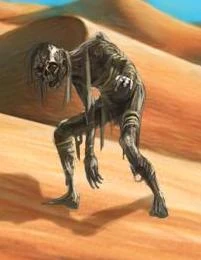
Waste Husk


No. Enc.: 1d4 (1d12)
Alignment: Chaotic
Movement: 120' (40')
Armor Class: 5
Hit Dice: 4
Attacks: 3 (2 claws, bite)
Damage: 1d4/1d4/1d4
Save: L2
Morale: 10
Hoard Class: XIX
XP: 245

Waste Husks are the dessicated remains of desert wanderers who have been driven mad by the harsh desert environment coupled with whatever toxins, mutagens, biologicals and radiation they've come across in their travels. They appear as humanoids suffering from extreme hunger that have their skin torn and abraded by the desert sands and heat, clad in rags and castoff clothing.

Eternally hungry, these creatures roam the wastelands that formed them, searching for any signs of life that they can consume. They often attack by running down their prey, rather than ambush, however, since they are immune to the sand storms and other weather that wracks these wastelands, they may be able to surprise victims on a roll of 1-5 on 1d6 during any weather that could conceal their approach.

While they generally wander the wasteland, they occassionaly can be found lairing in sand-swept or partially buried ruins out among the wastes, as well as sources of water such as an oasis or well.

Mutations: Energy Absorption (Heat) (CoTW), Natural Armor, Predatory Scent


DEATH SAILOR


No. Enc.: 1d10 (4d10)
Alignment: Chaotic
Movement: 60' (20')
          Swim: 120' (40')
Armor Class: 8
Hit Dice: 5
Attacks: 1 (weapon)
Damage: 1d6 or weapon type
Save: L2
Morale: 8
Hoard Class: XXII
XP: 500

Death Sailors are the waterlogged corpses of drowned seafarers. They appear as bloated, dark blue or purple, hideous-looking humanoids with wild, kelp-like tangles of hair, sharp teeth, and eyeless heads.

These creatures have an intense hatred of those who still sail on the surface of the sea, and will attack any vessel they think they can overwhelm. Death Sailors are typically armed with nautical weapons. Roll 1d12 to determine what weapon they have: 1 - Belaying Pin, 2 - Boarding Axe, 3 - Grappling Hook, 4 - Cutlass, 5 - Harpoon, 6 - Trident, 7 - Hawaiian Sling, 8 - Boarding Pike, 9 - Speargun, 10 - Harpoon Gun, 11 - Polespear, 12 - Marlin Spike.

Mutations: Increased Strength, Aquatic Mutation (NEW)


CYBONES


No. Enc.: 1d4 (1d4)
Alignment: Chaotic
Movement: 90' (30')
Armor Class: 8
Hit Dice: 6
Attacks: 2 (laser, electricity)
Damage: 6d6/4d6
Save: L3
Morale: 10
Hoard Class: None
XP: 1070

Cybones are what you get when a Cyborg Commando's biological parts have been damaged (generally by toxin, poison, or radiation) to the point where there is little drive left in the biological portion of the cyborg. The result is a slower, slightly weaker version of the Cyborg Commando, with only the barest of machine intelligence operating the body.

Mutations: Thermal Vision, Increased Physical Strength, Energy Ray (electricity)


JACK LANTERN


No. Enc.: 1 (0)
Alignment: Chaotic
Movement: 120' (40') when not mounted
          Mounted: As per stead, mount, or vehicle
Armor Class: 7
Hit Dice: 7
Attacks: 1 (weapon)
Damage: 1d6 or by weapon type
Save: L3
Morale: 10
Hoard Class: XXII
XP: 1140

Jack Lanterns are headless humanoids. They can take on a variety of appearances, typically dressing in leather outfits and carrying a 'head.' The head carried varies constantly, roll on the following table to determine what head is carried each time a Jack Lantern (even the same one!) is encountered:
Roll Head Type
1 Jack O' Lantern
2 Tree Stump
3 Decapitated Humanoid Head
4 Helmet
5 Robot Head
6 Decapitated Animal Head (roll on any animal table to determine animal type)
7 Wooden Log carved to look like a face
8 Carved Turnip

Jack Lanterns wander the decaying highways and roads of the wasteland searching for a suitable head. No one knows what criteria they use to determine what makes a head suitable, but any Jack Lantern that succeeds in finding a suitable head disappears and is never seen again. They will attack just about any creature in search of a suitable head. They favor edged weapons with which to decapitate their victims.

A wide variety of mounts, steads, and vehicles are used by Jack Lanterns for transportation. While there is no way to be specific, given that any campaign will have different creatures and vehicles present, this quick table will give GMs the basic mount for each Jack Lantern encountered: Roll 1d4: 1 - Common Riding Animal, 2 - Motorcycle, 3 - Hovercycle, 4 - Uncommon Creature used as a stead.

Mutations: Aberrant Form (Detached Limb) (NEW), Fuse Body Part (Head only) (NEW)


VAULT DRAUGR


No. Enc.: 1d4 (4d4)
Alignment: Chaotic
Movement: 90' (30')
Armor Class: 6
Hit Dice: 8
Attacks: 1 (cold touch or by weapon)
Damage: 1d10 or by weapon type
Save: L4
Morale: 10
Hoard Class: XXI
XP: 1560

Vault Draugr are the result of imperfectly cryogenically preserved pure humans stored in cryogenic vaults to avoid the apocalypse. They generally appear as pale, ice-covered humanoids. Essentially brain-dead, they have only the bases instincts.

These creatures tend to attack any other creature they encounter for food, or possibly mating, occasionally both. While they cannot operate complex artifacts, basic melee weapons are well within their capability.

Vault Draugr tend to lair near the cryogenic vaults they were revived in, and are rarely found wandering the wastes.

Mutations: Energy Touch (Cold) (as per Energy Ray, but range is touch), Energy Absorption (Cold) (CoTW)


SANGUINE FIEND


No. Enc.: 1d4 (1d6)
Alignment: Chaotic
Movement: 120' (450')
Armor Class: 2
Hit Dice: 9
Attacks: 3 (claws, bite)
Damage: 1d6/1d6/1d10
Save: L5
Morale: 10
Hoard Class: XVII
XP: 3800

Sanguine Fiends are mutant blood-drinking humanoids. They generally appear as pale humanoid mutants, with sharp teeth or fangs. They may also have other abnormal features, such as pointed ears, glowing eyes, being completely hairless, or having long, pointed fingernails.

These foul beasts hunt other mammalian mutants in order to drink their blood. However, due to their Epidermal Susceptibility, they can only hunt at night.

Sanguine Fiends lair in dark places not easily invaded by sunlight, such as deep caves, completely windowless buildings and structures, or deep in the darkest portions of ruined communities.

Mutations: Increased Physical Strength, Epidermal Susceptibility (Sunlight), Dietary Requirement Change (Blood) see CotTW, Natural Weapon


RADIATION KING


No. Enc.: 1 (1)
Alignment: Chaotic
Movement: 120' (40')
Armor Class: 0
Hit Dice: 12
Attacks: 1 (weapon)
Damage: 1d6 or by weapon type
Save: L6
Morale: 12
Hoard Class: XV
XP: 4400

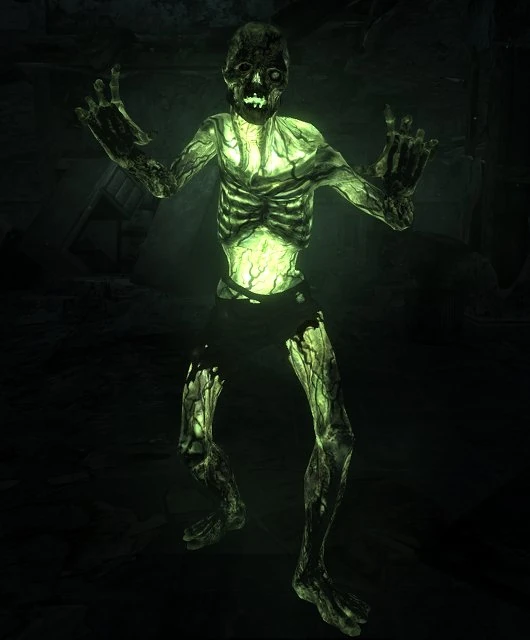
These animate corpses are generally considered the most intelligent of all the post-apocalyptic 'undead.' They essentially died (cannot regenerate biological material (i.e. heal) by normal means) due to their exposure to massive amounts of radiation.

Radiation Kings are generally uninterested in feeding on other creatures, preferring instead to increase the amount of radiation they are able to absorb. However, if their activities are disturbed, they are quick to deal with opponents with any means at their disposal. Vitims are usually dealt with by the radiation field the creature continually radiates. This field does Class 10 Radiation damage within 10', Class 7 Radiation Damage from 11-20', Class 4 Radiation Damage from 21-30', and Class 1 Radiation Damage from 31-50'.

Radiation Kings lair in highly radioactive areas, though they can sporadically be found wandering the wastes in search of radioactive objects and areas.

Mutations: Energy Field (Radiation, see above), Energy Absorption (Radiation), Extended Lifespan, Dietary Requirement Change (Radiation)


NEW & REVISED MUTATIONS:

Aberrant Form (Detached Limb) (New; Beneficial Physical Mutation)
The mutant can detach one of it's limbs, randomly determined by the following table (Roll 1d4: 1 - arm, 2 - hand, 3 - leg, 4 - head). The limb can be commanded as if telepathy exists between the main body and the limb. Such limbs are limited to one half the movement rate of the main body, have 1/4 the hit dice, and have one meager 1d4 attack per round.

Aquatic Mutation (New; Beneficial Physical Mutation)
This mutation generally manifests as the development of webbed hands and feet, allowing the creature to be able to swim at double land speed. In addition, the creature takes half damage from cold attacks. This mutation does not proved the character with the ability to breathe underwater. Due to the nature of this mutation, the mutant suffers from the effects of Epidermal Dependency (Water) as per Creatures of the Tropical Wastes.

Fuse Body Part (New; Beneficial Physical Mutation)
This mutation allows a character to meld any body part or body part-like object to their body, and use the body part as per the Aberrant Form (Xenomorphism) mutation. The type of body parts that can be fused include arms, legs, wings, heads, tentacles, vines, eyestalks, claws, talons, pincers, prehensile tendrils, stingers, tails, wings, horns, etc. within the limitations of the GM. Roll on the following table to determine how many additional body parts can be fused to the mutant (Roll 1d6: 1 - one, 2 - two, 3 - 1d4, 4 - 1d6, 5 - 2d4+2, 6 - 1d20).

Troglodytism (New; Physical Drawback)
This genetic change generally occurs in creatures who have evolved to live underground. Creatures with this drawback will be very reluctant to venture above ground, and any time they are above ground, whether the sun is out or not, they must make a Saving Throw vs Stun Attacks or flee as far underground as possible at full movement for 1d4 rounds. Additionally, the being is highly sensitive to light, and suffers a –2 penalty to hit when in daylight.

Wing Development (Revised)
The mutant has developed a full set of wings. The mutant may fly while carrying only 25% of his body weight. Roll on the table below to determine type.
Creatures weighing between 150 and 300 pounds lack the utility of Full Wings, but can travel long distances by drifting on air currents (speed depends on wind conditions). The creature can fly 500 miles without rest, but must sleep after landing. The mutant must have at least 1,000' feet of clear ground or 50' of elevation to build the necessary take-off speed. Landing requires a large open space.
Creatures over 300 pounds cannot use these wings for flight, but they leap to a distance of 120’, with a maximum height of 80’.
Mutants with Bone Wings or Elytra can use them to make one physical attack per round, causing 1d6 damage. Bat Wings and Pterosaur Wings have tiny hands or barbs located on the top joint. With the ML’s permission, the hands can be used as manipulator limbs; or, they could both be used in combat, where they do 1d4 damage as either a bash or barb.
Wing Type Table
1 Elliptical Bird Wings This is the most common type of bird wing, often found among passerines. These type of wings are short and rounded, allowing for tight maneuvering and rapid take off when evading predators. With these wings the character can fly with a movement of 120’ (40').
2 High Speed Bird Wings Wings that are short and pointed, requiring rapid wingbeats to provide high speed but with high energy expendeture. This type of wing is found among the fastest birds, such as the peregrine falcon. With these wings the character can fly with a movement of 480’ (160').
3 High Aspect Ratio Bird Wings These wings are longer than they are wide, and are used by birds that generaly soar or glide, such as seabirds. The length of these wings means that the creature requires a longer taxi in order to become airborne, at least 1000' of clear ground or 50' of elevation. With these wings the character can fly with a movement of 90’ (30').
4 Soaring Bird Wings Shorter than high aspect wings, these wings have slots at the end of the wing to reduce drag, allowing the avian to have shorter take off characterstics. Wings of this type are commonly found among the larger inland birds, such as eagles and vultures. With these wings the character can fly with a movement of 180’ (60').
5 Bat Wings These wings are thinner than those of birds, which allows mutants with these wings to maneuver accurately and more quickly than birds. With these wings the character can fly with a movement of 120’ (40').
6 Pterosaur Wings Wings similar in design to bird wings, but much more leathery, and generally larger. With these wings the character can fly with a movement of 180’ (60').
7 Dragonfly Wings The mutant’s two pairs of wings double her flight speed to 240’ (80’). However, they are very fragile: any hit from behind or while flying has a 50% change of tearing the wings, and making them useless for one week. But they do heal, unlike insect wings.
8 Beetle Elytra These wings have a protective case, which could be anything from bone or chitin to leathery skin flaps. When the mutant initiates flight, his Elytra open to reveal the more delicate wings beneath. Flight speed is slow, 60' (20'), but without the chance of being damaged in ground combat. If the mutant is flying, there is still a 50% chance the wings are damaged and made useless by a ranged attack. These wings often buzz loudly, which can be heard for quite a distance.
9 Fly Wings These insect wings are a single pair of membranous and transparent wings. They can be damaged as per Dragonfly Wings. With these wings the character can fly with a movement of 120’ (40').
10 Bee/Wasp Wings While at first glance, these wings appear similar to Fly Wings, they actually consist of two pairs of wings held closely together by hooks. They can be damaged as per Dragonfly Wings. With these wings the character can fly with a movement of 150’ (50').
11 Butterfly/Moth Wings With the most diverse variety of shapes (and coloration patterns) in insect wings, these pair of dual wing sets are generally coupled together, with the forewing forcing the hindwing to move in the same direction. These wings are covered in scales which makes them somewhat more resistant to damage than other insect wings. With these wings the character can fly with a movement of 180’ (60').
12 Bone Wings These wings are extensions of the mutant’s skeleton, making them heavier and tougher than most wings. A strong interlacing web of fine bones connects the support structure, allowing the mutant to fly. Due to her rugged wings, the mutant gets a 2-point AC bonus when attacked from behind. But the weight reduces flight speed to only 90’ (30’).

Monday, December 15, 2014

Mutant Monday

This will be a bit stranger than my normal selection for Mutant Mondays. Today, I want to talk about a certain type of creature not usually seen in RPGs, the Animal Eye Spy/Messenger. These creatures generally appear in various works of fiction, such as the Crebain of Lord of the Rings, Gwythaints from the Chronicles of Prydain, crystal eye bats from The Dark Crystal, various corvid species in general, etc. I'm not really talking about wizard & witch familiars that can be used for spying or carrying messages, or any sort of power that lets a person see through an animal's eyes or control animals, but rather, species of creatures that have the ability to search out their master's foes and carry messages, like the examples listed.

Seeing the lack of such creatures, I thought I'd stat up a few, though they're generally geared more toward traditional fantasy than post apocalyptic settings.

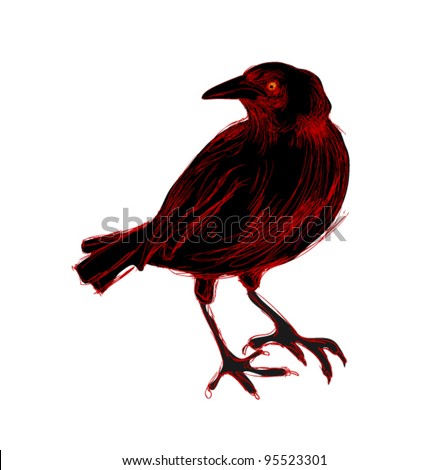
Crimson Crow


No. Enc.: 4d4 (4d4)
Alignment: Chaotic
Movement:
          Fly: 270' (90')
Armor Class: 6
Hit Dice: 2+4
Attacks: 1 (eye peck or claw)
Damage: 1d2/1d4
Save: L1
Morale: 8
Hoard Class: VI
XP: 59

Crimson Crows are large, crows of a dark red color, typically 3 feet long with wingspans of about 5½ feet. They primarily feed on small animals, specifically rodents, rabbits and hares, small swine, various procyonids, and mustelids. They will also feed on the carcasses of any larger creatures that they encounter, though they rarely attack anything more than 1½ their size.

These disreputable creatures are known to serve powerful Chaotic aligned creatures as spies and informants, trading their services for meat and shiny gee-gaws which they hoard in their nests. While they have excellent vision, equal to an eagle's eyesight, they also have decent nightvision and ultraviolet vision. They are also able to communicate intelligently, with a vocabulary of several hundred words.

Mutations: Increased Vision, Bizarre Appearance


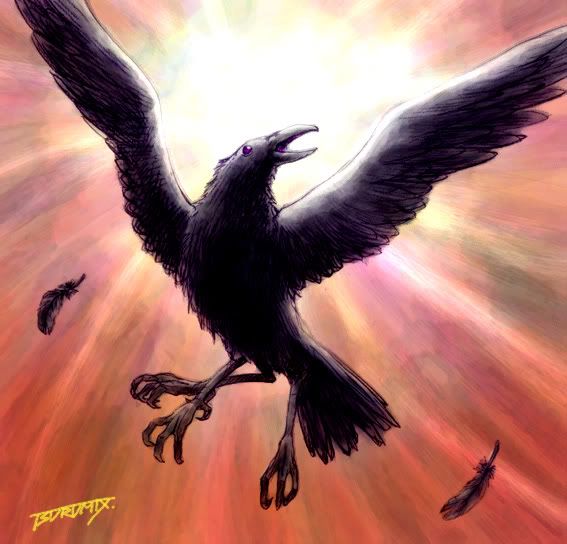
Night Raven


No. Enc.: 1d6 (2d4)
Alignment: Chaotic
Movement:
          Fly: 180' (60')
Armor Class: 5
Hit Dice: 3+3
Attacks: 2 (2 claws or bite)
Damage: 1d6/1d6/2d4
Save: L2
Morale: 9
Hoard Class: II (x3)
XP: 205

These huge, sleek predators appear as dark blue-black crows about 6' long with wingspans of 10-12 feet. Night Ravens are evil and known to serve as scouts and spies for any Chaotic being that can meet their price, 30 pieces of silver per job, with very specific contractual requirements, communicated through Neural Telepathy.

As they are nearly man-sized, they are known to prey extensively on humanoids, though only those they outnumber at least three to one, or who appear weakened, diseased, wounded and unarmed and easy prey. Uninterested in corpses and other animals, they prefer only live prey.

While they have excellent Nightvision, they primarily hunt prey with their mental abilities; Empathy and Track Mind (Creatures of the Wasteland) to locate targets, and Neural Telepathy to extract information.

Mutations: Gigantism, Empathy, Track Mind (CotW), Neural Telepathy


Dire Corbie


No. Enc.: 1 (1d4)
Alignment: Chaotic
Movement:
          Fly: 120' (40')
Armor Class: 4
Hit Dice: 4+2
Attacks: 3 (3 claws)
Damage: 2d4/2d4/2d5
Save: L3
Morale: 10
Hoard Class: XIX
XP: 245

Dire Corbies are immense, 8 foot long, three-legged crow-like creatures with a wingspan of 15-16 feet. While not quite large enough to be used as mounts by average-sized humanoids, they are occasionally known to carry small humanoids or creatures, though they will never act as steeds, instead, carrying the creature in their claws. These rare creatures will be found employed by only the most powerful Chaotic aligned villains, as the price of their service is often very high, typically multiple artifacts (magic items).

Thorough carnivores, they will attack just about any creature that they could possibly consume. Generally they attack by sinking all three claws into a victim in a swoop attack, and if they successfully connect, lifting the target into the air, to drop them from a considerable height.

Dire Corbies gather information with their powerful sight, increased range of vision, nightvision, ultraviolet vision, thermal vision, and 360 degree vision, allowing them to visually observe just about any target within miles of their location.

Mutations: Increased Sight, Thermal Vision, 360-Degree Vision (Creatures of the Wastes)


Spyder


No. Enc.: 1d8 (1)
Alignment: Chaotic
Movement: 120' (40')
          Web: 120' (40')
Armor Class: 6
Hit Dice: 2+2
Attacks: 1 (bite)
Damage: 1d6, poison
Save: L1
Morale: 7
Hoard Class: VI
XP:

Spyders are a mutated breed of giant hunting spider with a single large eye that can transmit its images to a selected recipient. Generally, dark grey to black in color, these 1' long spiders are hairy and of a fairly placid disposition. Unlike many other types of spiders, Spyders do not spin webs, although they can negotiate webbing, vertical surfaces, and even cling to ceilings.

While primarily passive observers, Spyders can attack humanoids, usually by leaping at their target to bite. They can leap up to 40', allowing them to cross large gaps, attack prey, or flee. Their venom contains a Class 12 poison.

When not being actively used to spy for their masters, they lair in large, dark caves and ruins, avoiding light, though they are not nocturnal or even light-blind.

Mutations: Gigantism, Increased Vision, Reverse Clairvoyance (NEW)


Eye Bat


No. Enc.: 1d6 (3d6)
Alignment: Chaotic
Movement:
          Fly: 240' (80')
Armor Class: 7
Hit Dice: 2
Attacks: 2 (2 claws)
Damage: 1d2/1d2
Save: L1
Morale: 7
Hoard Class: None
XP: 47

Eye Bats are large grey-brown, bat-like creatures with a wingspan of 4-6 feet, and a large, single eye in place of a head. Employed by intelligent Chaotic beings of all stripes, they are used as ocular scouts to find targets for their masters. Generally unintelligent, they must be telepathically guided to their target(s). Oddly, since they have no known mouthparts, it is unknown what they consume, or even if they eat at all.

Their masters rarely use Eye Bats for combat, attacking only as a last resort (although a few villains are known to habitually sacrifice Eye Bats as one-shot kamikaze weapons against their foes).

It is not known how Eye Bats are produced (or reproduce, if they do so), however, with their acute vision and mental capabilities, they do make excellent spies.

Mutations: Bizarre Appearance, Reverse Clairvoyance (NEW), Mental Slave Bond (NEW)


Wyrmpire


No. Enc.: 2d4 (2d4)
Alignment: Chaotic
Movement: 60' (20')
          Fly: 180' (60')
Armor Class: 5
Hit Dice: 3
Attacks: 3 (2 claws, bite)
Damage: 1d4/1d4/1d6
Save: L1
Morale: 9
Hoard Class: None
XP: 95

Wyrmpires are flying bird-lizard creatures with grey skin and black wings. Though small (about 2 feet long with a wingspan of 3 feet), they can be fairly dangerous, as they are known to be blood drinkers. Somewhat intelligent, these creatures are sometimes employed by Chaotic masters as spies and scouts. However, they have only a limited ability to communicate, generally a vocabulary of 100 or so words.

These creatures will attack just about any mammal, humanoid or otherwise, but only if the creature is small enough to physically overpower, or somehow restrained, incapacitated, paralyzed, asleep, or otherwise immobile. When attacking a target, they prefer to grip with both claws and then physically biting their victim in order to drain blood (1d6 damage per round that they are in contact with the victim).

Mutations: Bizarre Appearance, Complete Wing Development, Dietary Requirement Change (Blood, see Creatures of the Tropical Wastes)


New Mutations
Reverse Clairvoyance (Beneficial Mental Mutation)
This mutant can transmit visual images to a selected recipient up to 100’ away, allowing the recipient to see as if they were standing on that spot.

Mental Slave Bond (Mental Drawback Mutation)
This power functions as if the mutant is under the effects of the Possession mutation, with some differences. Unlike Possession, the creature in control is not directly controlling the victim, but rather issuing mental commands which must be obeyed (Mental Combat with a -4 to WIL for a mutant with the Mental Slave Bond to resist the command). Neither is the controller directly receiving sensory information from the mental slave, instead they must concentrate to receive information and/or pass on mental commands. If the controller is concentrating on the linkage to the mental slave, and that mental slave is killed, the controller must save vs stun attacks or be rendered unconscious for 1d6 hours.

Monday, November 10, 2014

Mutant Monday

Dark Bramble


No. Enc.: 2d4
Alignment: Neutral
Movement: None
Armor Class: 9
Hit Dice: 2
Attacks: 1
Damage: by mutation, or see below
Save: L1
Morale: None
Hoard Class: None
XP: 56

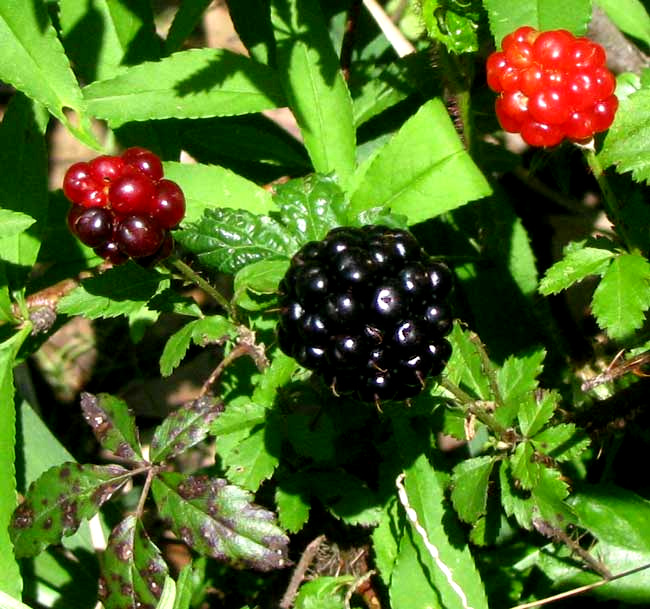
A species of unintelligent, mutated Rubus flagellaris (Common Dewberry) that range from 8 to 15 feet long, up to four feet high. The main body consists of a woody taproot with 4d4 low growing stems which have hard prickles that can cut unprotected flesh, doing 1d4 damage to those who come into physical contact with the plant. The stems are covered in green leaves that are pale on the underside and form an alternate compound arrangement of three to five leaflets. Also present are white, five-petaled flowers which open during the day and close at night. Lastly, the aggregate fruit of this plant consists of 3d6 dark purple berries per stem which resemble blackberries.

To someone unfamiliar with the Dark Bramble, the plant looks much like any other bramble. This makes them surprisingly difficult to distinguish from normal brambles, at a distance of more than 10 yards, surprising beings on a surprise check roll of 1-3 on 1d6. Because of their body form, blunt or piercing weapons (including projectiles) cause but a single point of damage on a successful attack. Whereas slashing weapons, fire, or other attack forms generally have their normal effect. Dark Bramble attack with their Disintegration mental mutation when humanoids approach within 50 feet.

These plants grow in a variety of soils and are found in bogs, savannahs, sandy regions, abandoned files, meadows, and woodland borders. They survive and repopulate by attracting animals such as chipmunks, mice, racoons, squirrels to eat their berries as well as a large variety of aphids, bees, and butterflies. While a nuisance plant, their leaves, unlike their inedible berries, can be used to make delicious teas or eaten raw.

Mutations: Disintegration, Full Senses, Edible Leaves (NEW), Inedible Berries (Inedible Fruit from Creatures of the Wastes)

New Mutation (Beneficial Plant Mutation)
Edible Leaves
This power functions similar to the Edible Seeds mutation from Creatures of the Tropical Wastes, and should probably include Edible Bark as well. There are also some new additions to the list of effects:
Roll Effect
9 (replaces old 9-10 option) Tasty, acts as one ration of food.
10 (replaces old 9-10 option) Nutritious, acts as full day's worth of food.
11 Sugary Energy, restores CON to normal for 1d4 hours, or reduces Fatigue by one step (if used).
12 Disease Vaccine, randomly roll type of Disease cured.
13 Narcotic (depending on what rules for drugs are used).
14 Booze (depending on what rules for drugs are used).
15 Meat Substitute, acts as a normal ration of food for carnivores.
16 Poison Antidote, randomly roll type of poison cured.
17 Radiation Antidote, 1/2 damage from any radiation during that day.
18 Energy Absorption, (randomly rolled) for 1d4 hours.
19 Epidermal Photosynthesis for 1d6 hours.
20 GM's Choice

Monday, October 6, 2014

Mutant Monday

Red Tide


No. Enc.: 0 (1d2)
Alignment: Neutral
Movement: 90' (30')
          Swim: 90' (30')
Armor Class: 9
Hit Dice: 5
Attacks: 2 (bite, tail)
Damage: 2d8, 1d8
Save: L2
Morale: 8
Hoard Class: None
XP: 650

These serpentine creatures are a heavily bio-engineered form of Karenia brevis, the dinoflagellate responsible for the "Red Tide" harmful algal bloom found along the Gulf Coast. A Red Tide appears as a reddish or pinkish serpent, approximately 120' long and 12' in diameter. The head appears as a distinctive bulge containing a large mouth and no discernible eyes.

Typically found near the surface of the ocean, attacking prey from behind or underneath, detecting their victims by motion. They may attack with both a bite and a tail slap in 1 round. If a Red Tide’s bite attack roll is at least 4 higher that the roll needed to hit (or a 19 or 20 are rolled), a victim is swallowed. A being that is swallowed takes 3d6 hit points of damage per round inside the Red Tide’s belly. The damage stops when the character dies or the Red Tide is killed.

Red Tides can also use their powerful bodies to create a small, but powerful wave in the water, similar to a tsunami. This wave propagates out to the side of the Red Tide covering an area 60' by 60'. Everyone in that area must make a save versus energy attacks or take 2d6 points of damage and be submerged. Those that save just take 2D6 damage. Against ships and boats the wave does 2d6 shp and has a 80% chance of capsizing a galley-sized or smaller vessel and a 50% chance of capsizing a sailing ship.

Mutations: Abnormal Size (Gigantism), Carnivore, Free Movement

Sargasso Sulfinator


No. Enc.: 1d4
Alignment: Neutral
Movement: None
Armor Class: 9
Hit Dice: 6
Attacks: See below
Damage: 1d8 swat, 2d10 crush
Save: None
Morale: None
Hoard Class: XIX (x2)
XP: 1020

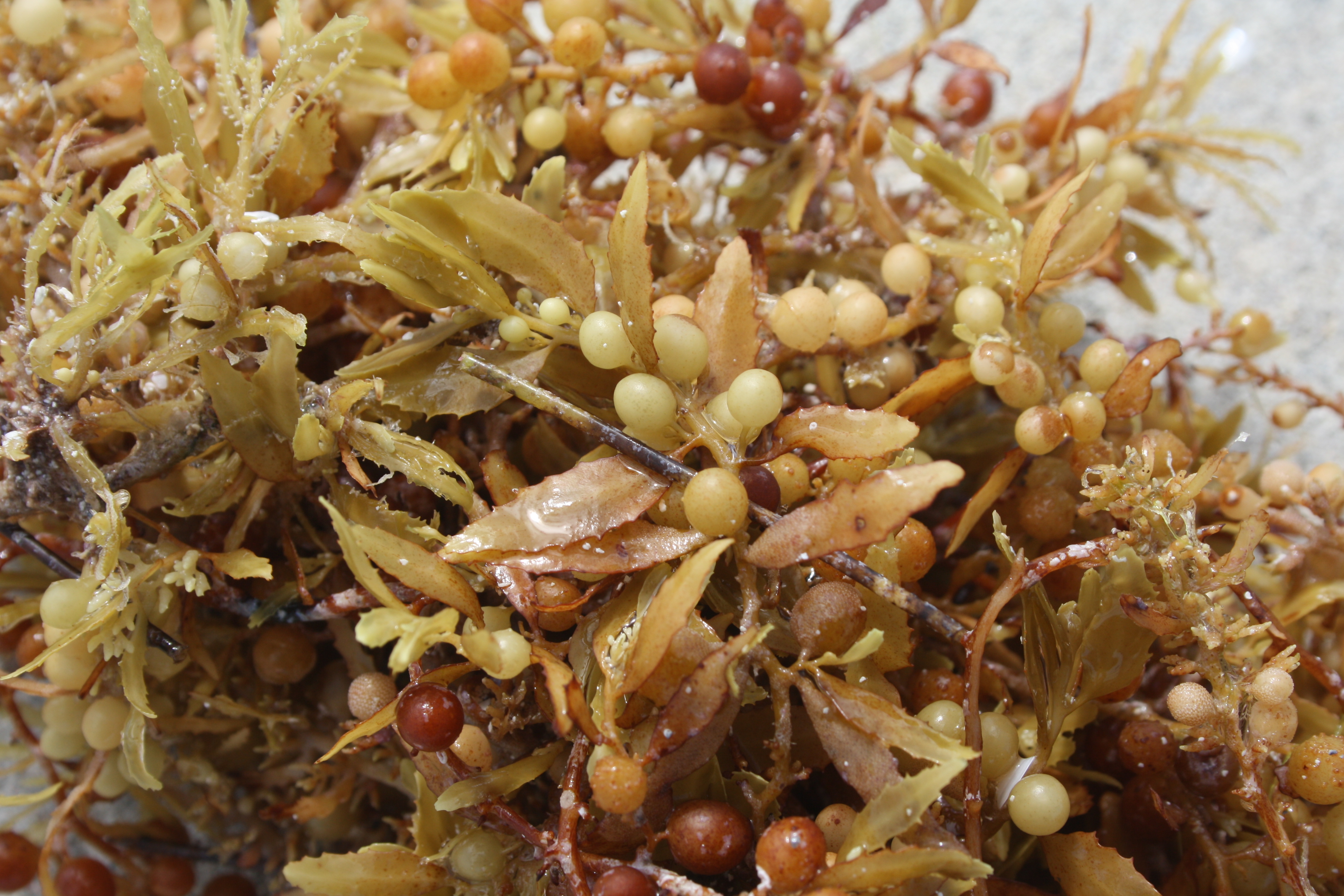
A mutated species of Sargassum seaweed that has evolved into a carnivore. A Sargasso Sulfinator is composed of a collection of 4d6 brown seaweed fronds with grape-like gas-filled bladders surrounding a central core. Appearing as a normal mass of sargasso, 1d20x10' in diameter, floating on the surface. Because of this, beings must make a surprise check roll of 1-3 on 1d6 to notice the danger posed by Sargasso Sulfinators. The mouth of the creature is hidden near the the center of the mass.

When prey approaches, a Sargasso Sulfinator attacks with 1D4 of it's fronds. If prey is hit, the creature will attempt to drag the victim into its huge mouth. It takes two rounds for the victim to reach the mouth, and five rounds later the victim is completely digested by the immensely powerful digestive agents within. Each frond can receive 6 points of cutting damage before being severed; severed fronds regenerate fully in 2d6 days.

In addition to physical attacks, if the creature takes damage, there is a 50% that several gas bladders will be punctured, releasing a toxic cloud of gas (Class 7 poison) in a 30' radius.

Mutations: Toxic Weapon, Prehensile Tendrils (Constrictive), Carnivore

Sirenweed


No. Enc.: 1 (2d4)
Alignment: Neutral
Movement:
          Swim: 120' (40')
Armor Class: 7
Hit Dice: 4
Attacks: 1
Damage: 1d4
Save: L2
Morale: 6
Hoard Class: XXI
XP: 355

Mutated versions of Macrocystis pyrifera, these aquatic creatures can be found lairing among vast seaweed beds among the coasts. About 14 feet in total length, Sirenweeds appear, from the waist up, as green or brown skinned humanoid females, with long, flowing hair. From the waist down, generally underwater where it can't be seen, the body appears as a long sea serpent, with a long narrowing tail, covered in long, delicate fins, and ending in a wide, fan-shaped fluke.

Sirenweeds generally attack by using their Captivate mutation to lure in victims, which they then drag underwater to be drowned and consumed. Against aquatic prey, they instead pummel the victim to death.

Mutations: Animal Limbs, Captivate (new), Carnivore, Free Movement, and Full Senses


NEW MUTATION (Beneficial Mental Mutation)
Captivate
This mutation allows the mutant to produce an invisible field that is enticing to all living creatures. The radius of the field is 50 feet and any creature inside the area of effect must make a save vs. energy or be so enticed will stay as close to the mutant as possible and try to protect it, even to the point of fighting other creatures that draw near. Every 5 rounds anyone enticed by the field may make another saving throw. Until the victim is successful, he will stay near the mutant until he dies from drowning, dehydration, or starvation (whichever comes first).