
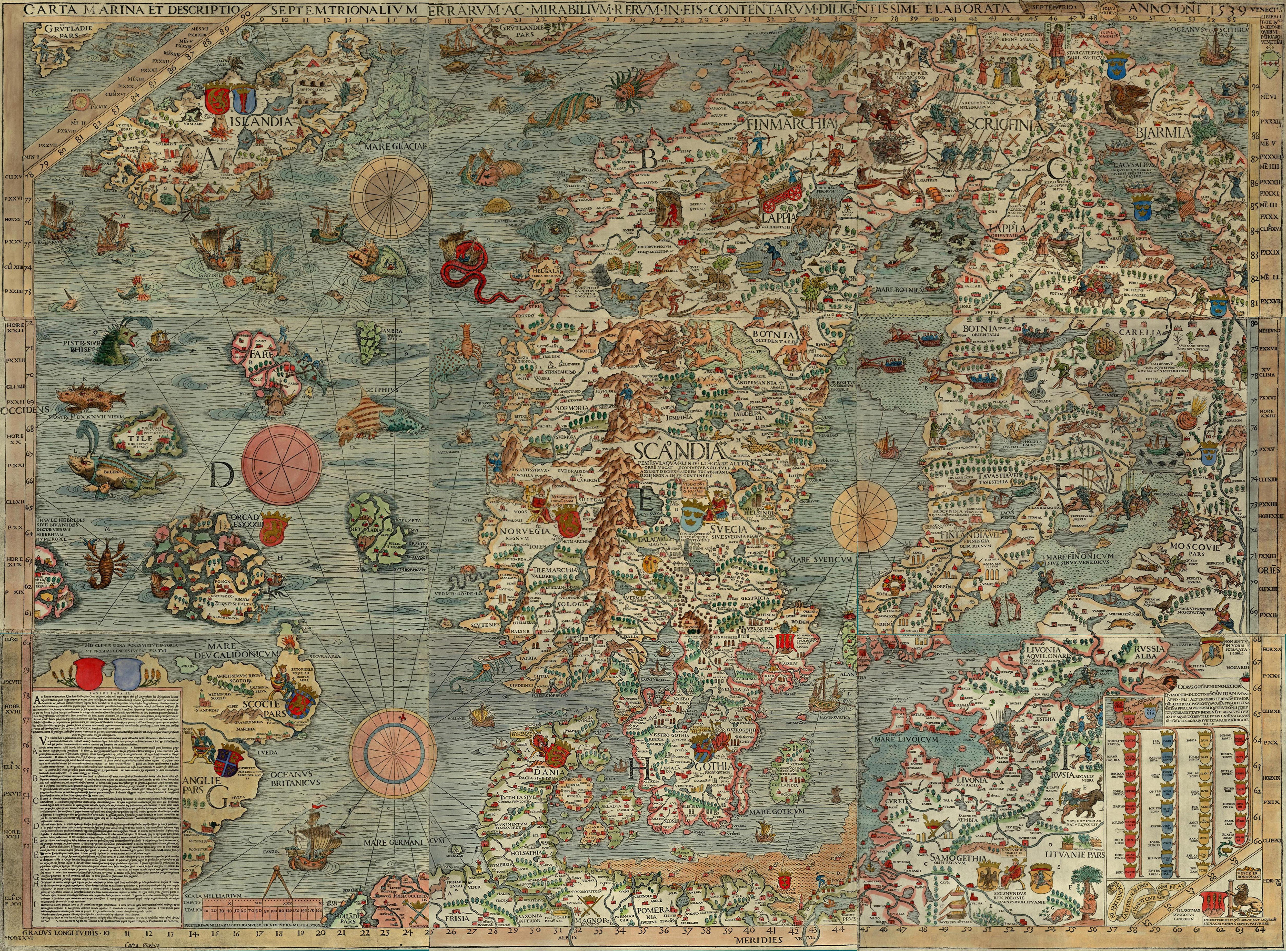
The Land of Nod blog has a series of articles that cover several of these creatures: Medieval Bestiary
 Abarimon - A bestial, savage race of people who have backwards feet, yet can run at great speed.
 Afanc - Welsh lake monster, also known as Addanc or Avanc, resembling a crocodile-beaver.
 Al Mi'raj - An Arabic creature described as a yellow rabbit with a two foot long spiraling black horn projecting from its forehead. Known for being fiercely territorial and having a voracious appetite. Also called Miraj, Mi'raj, and Mir'aj.
 Alerion - A heraldic large eagle, displayed without beak or talons. Also called Avalerion
 Allocamelus - Heraldic "Ass-Camel," having the body of a camel with the head of a donkey (representing a llama).
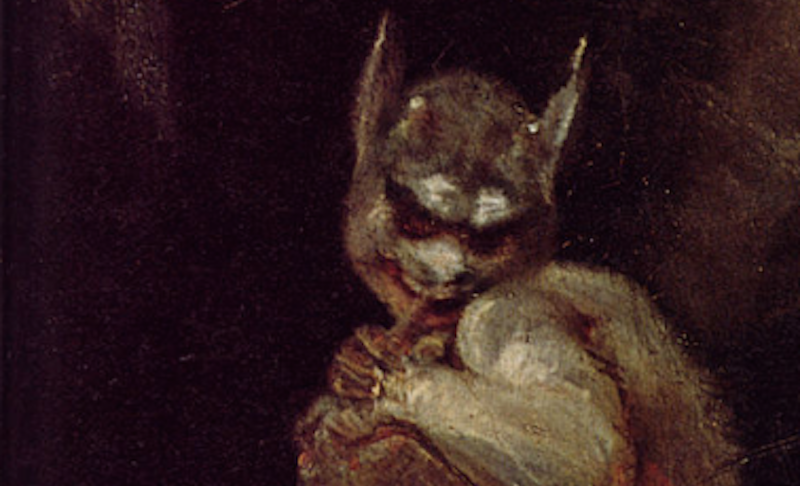 Alp - A Germanic shapeshifter, may be classified as fey (elf), undead (vampire or spirit), or demonic (incubus). More information at Alp.
 Alphyn - Germanic Heraldic beast (from the German for "chaser" or "wolf"), this chimeric creature is a lion-wolf hybrid, depicted as a stocky quadreped with a white, airy body, thick, golden, tufted mane, long, thin tongue and triple knotted tail. It may have eagle or dragon talons on its forelegs, or the cloven, goat-like hooves. It may also be depicted with all four legs bearing lion's claws.
 Amphiptere - Heraldic winged serpent. It is not a feathered serpent, having instead, bat-like wings and is usually green or greenish-yellow in coloration. Also called Amphithere, Amphitere, or Phipthere.
 Anthropophagus - Also known as androphagi ("man-eaters"), this race of people from Greek mythology were cannibals, sometimes confused with blemmyaes.
 Amphisbaena - Originally a snake with a head at each end of the body, by medieval times, it had morphed into a horned cockatrice with a snake-headed tail. Known for eating ants, it is also called "Mother of Ants." Also known as Amphisbaina, Amphisbene, Amphisboena, Amphisbona, Amphista, Amfivena, Amphisien Cockatrice, Amphivena, or Anphivena (the last two being feminine).
  Arimaspians - A Greek mythical peoples, described as one-eyed men who battled griffins for their gold.
 Aspidochelone - A whale-turtle with huge spines on its back that is so large that it resembles an island, often developing sandy beaches, rocky crags and tree-filled valleys. While it produces a sweet scent to hunt the fish that are its prey, it is most notable for luring sailors to their doom. The typical tale of a ship's crew mooring to the "island" and then when they go to light fires for cooking, the creature dives deep into the water, taking the sailors and moored ship with it down to the depths. Also called Aspedocalane, Aspido testudo, Aspidoceleon, and Aspis chelone. Pliny the Elder identifies this creature as "pristis" (of immense size) which may related to Pristers (q.v.).
 Astomi - Greek mythical peoples who consume pleasant scents, such as flowers or fruits instead of food or drink. They are depicted with hairy, rough bodies and no mouths and can be killed by smelling strong, unpleasant odors.
 Balena - Monstrous whales from cartographic maps, sometimes called Troll Whales or Devil Whales.
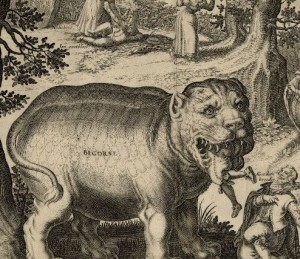 Bicorn - Also called Bicorne or Bulchin. While the name would indicate a creature with two horns, the depictions of this creature describe a fat, well-fed panther with a human face that feeds well on "hen-pecked husbands." It has an underfed counterpart known as a Chichevache which feeds onoly on "hen-pecked wives."
 Blemmyae - A Greek mythocal race of headless men whose facial features could be found on their chests. Also known as Akephaloi ("headless ones"), with Epiphagi appearing as a variant name for those whose eyes could be found on their shoulders rather than on their chests.
 Bonnacon - Mythical bull-like creature, with the mane of a horse, and horns that curl uselessly in to the degree that they provide no defense. Known for it's acidic or burning dung which can be fired as far as two acres. Also called Bonacon or Bonasus.
 Caladrius - Snow-white bird that can detect and possibly cure disease and illness.
 Calopus - Roman variant of the antelope, "pretty foot." Appears as a roe deer with large saw-blade horns. Also called Aeternae, Analopos, Antalope, Antholops, Aptaleon, Aptolos, Jachamur, Jachmur, Jamur, Pantolops, and Yamur. Often confused with the Chatloup ("cat-wolf"), a wolf-bodied creature with the head of a cat and goat's horns.
 Calygreyhound - Heraldic beast described as having a cat's head with laurel-like antlers, an antelope body, eagle talons on its forelimbs with ox hooves on its hind limbs and a tufted tail like that of a lion or poodle.
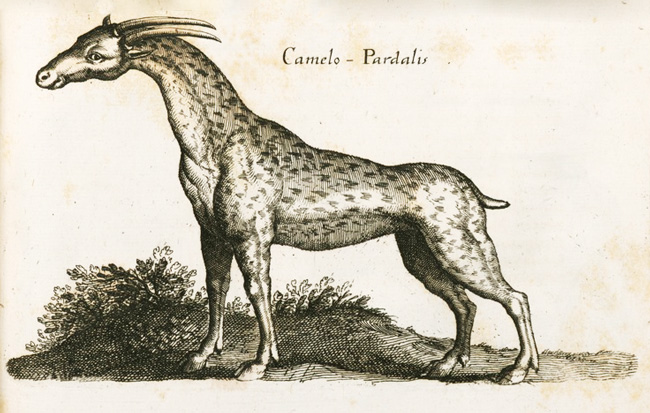 Camelopard - Heraldic depiction of a giraffe, described as a long-necked camel with the skin of a leopard. Also called Camelopardel, though this usually refers to a variant with swept-back horns.
 Catoblepas - A scaled, heavily-maned buffalo with a wild boar's head that is so heavy its blood-shot eyes always points down. The stare or breath of the beast was believed to kill or petrify people.
 Cerastes - Spineless horned vipers from Greek mythology with two ram's horns or four smaller horns on their head. They hide in the sand with only their horns protruding in order to lure prey in close.
 Cercopes - Greek, tailed, forest creatures known for their knaveries and mischief.
 Choromandi - Hairy, savage people of Greek origin with dog's teeth that communicate in horrible screams instead of recognizable speech.
 Crocotta - Also known oas Corocotta or Crocuta, a dog-wolf or lion-hyena hybrid with a powerful jaw plate instead of teeth, believed to alternate sexes each year and self-impregnate. Also known for human-like speech which is uses to lure men out where it can devour them. Some magical abilities are attributed to them, such as being immune to weapons of steel, having great strength and being fleet of foot, or being able to paralyze dogs. Often confused with the similar Leucrotta, a chimera with the body and tail of a lion, a badger's head, stag's legs and cloven hoofs, and a mouth that replaces teeth with ridges of bones, though the ability to imitate human speech is the same.
 Cynocephali - Dog- or jackal-headed humanoids originating from Greek myth. Also spelled Canocephalus.
 Echaneis - A remora-like fish that held ships in place by attaching themselves to the ship. Also called Echinius, Echinus, Enchirius, Essinus, Esynus , Remora, and Urchin.
 Enfield - Heraldic chimera with the head of a fox, eagle's talons on the forelegs, a greyhound's chest, lion's body and hindlegs and tail of a wolf.
 Ethiopian Pegasus - Two-horned pegasi believed to hail from Ethiopia.
 Fastitocalon - Giant whale that is basically identical to the Aspidochelone, but not as turtle-like.
 Forest Bull - Greek origin carnivorous red cattle, double normal size, with swiveling horns believed to hail from the forests of Ethiopia.
 Gegenees - Six armed giants from Greek mythology.
 Gorgades - Hair-covered female people from Greek sources that hail from Atlantic islands. May be related to the Satyrus.
 Hercinia - Also known as Ercinea or Harz Birds, these birds have brightly glowing feathers and hail from the Hercynian forest of Germany.
 Hippalectryon - A horse-rooster chimera from Greek mythology with the foreparts of a horse and the wings, tail, and hind legs of a rooster. Large enough to support a man-sized rider.
 Hippopodes - Horse-footed mythical humanoids believed by the Greeks to live on islands in the Baltic Sea.
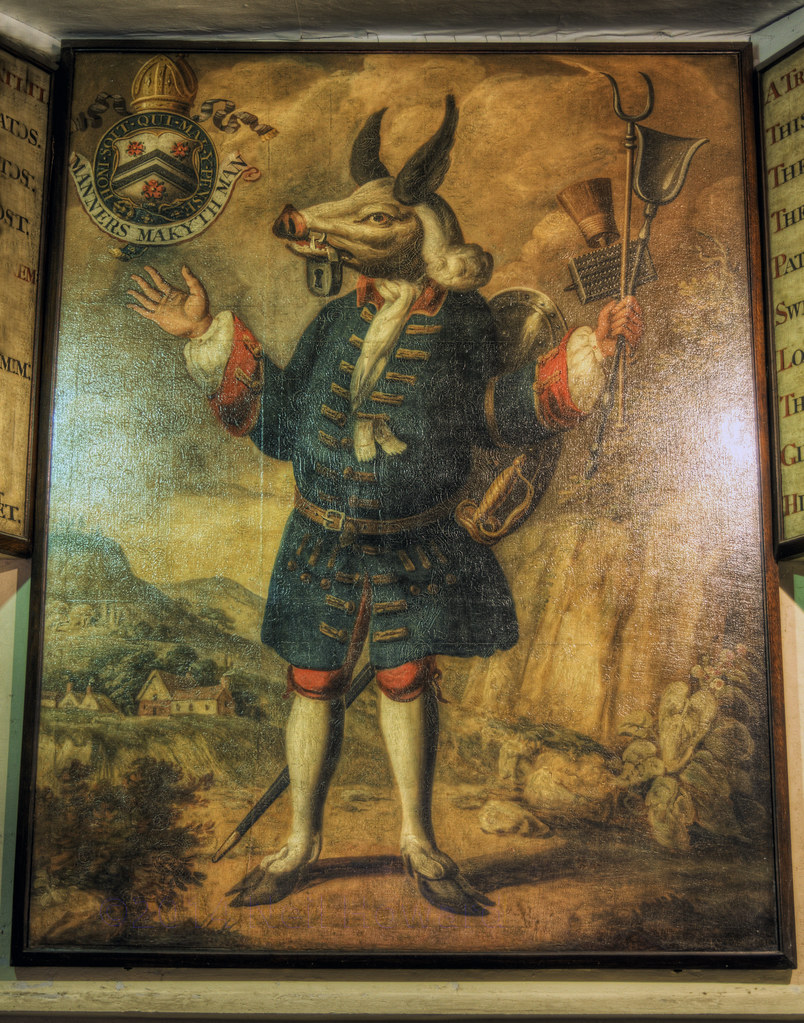 Hircocervus - A goat-stag or horse-stag humanoid hybrid also known as Tragelaph.
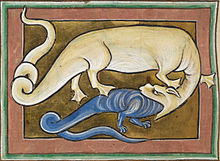 Hydrus - A serpentine, water dwelling creature with three heads hailing from the Nile, believed to pull a chest-bursting move on crocodiles which consumed them. Also called Enhydros, Enidros, Hildris, Hydra, Idra, Idres, Ydre, Ydris, and Ydrus.
 Ichneumon - A dragon killing creature (which may also kill asps and crocodiles), the name, which translates from Greek as "tracker" is used for the snake-fighting mongoose. It is only described in that it covers itself with mud and closes its nostrils with its tail in order to be swallowed and thus attack dragons from the inside. This may relate the creature to the hydrus. The Latin translation of "tracker" or Calcatrix is where the cockatrice derives its name and the Ichneumon is one of the few creatures not effected by a cocaktrice's petrification ability. It is also called Echinemon.
 Ichthyocentaur - This fish-centaur hybrid was originally depicted as a hippocampus, but later became a dolphin-tailed humanoid with lion or horse forelegs; a look associated with some tritons.
 Jaculus - Also known as Iaculus, this winged serpent is commonly called, "Javelin Snake," due to its hunting tactic of hurling itself from trees into its prey. Generally seen as a bat-winged green snake, it also appears as a white-feathered two- or four-leged serpent with dragon-like characteristics.
 Jasconius - This island-sized fish is similar to the Aspidochelone or Fastitocalon, the only real difference is that it is depicted as fish rather than whale or turtle.
 Karkadann - A unicorn-like creature hailing from the deserts and plains of Persia. Commonly described as a buffalo with scaly, black skin, three yellow hooves on each foot, a lion's tail, and a conical horn protruding from the nose that is said to have medicinal properties (as an antidote to poison).
 Keythong - A wingless griffin found in heraldic crests. Also known as Alce.
 Lampago - Heraldic beast in the form of a man-tiger, with the body of a lion or tiger and man's face. Also called Lympago. It is similar to the manticore-like Satyral, a creature described as having the body of a lion, two ox-like or anteleope horns, the tail of an antelope, and an elderly man's bearded face.
 Leontophone - Small creature that is the enemy of lions either poisoning them while eaten, or being burned and having their ashes used to taint meat that is left out for lions.
 Libyan Aegipanes - One of the many variant sub-species of satyrs. Satyrs themselves are basically goat-horned humanoids (with constant erections, that drink alot), occasionaly depicted as having the lower body of a goat as well, though this later association more properly defines the Roman Faun and the Greek Pan-like creatures known as Panes. Some confusion also exists with regards to the Sileni, horse-legged humanoids who later became conflated with the deity Silenus. Red-haired satyrs were known as Satyros Satyrides or the Latin Satyrus and hailed from remote Atlantic islands. Eithiopian Satyrs were considered violent, though they could be pacified with strong drink. Libyan Panes (occassionally called Libyan Satyrs) are typically depicted has having horse-like ears and tails, making them similar to Sileni.
 Lindworm - As a heraldic beast, lindworms are depicted as venomous, wingless, bipedal dragons. Norse depictions show a constricting sea serpent with glowing eyes in it's horse-like head with front claws (instead of a wyvern's hind claws).
 Machlyes - Greek mythical people hailing from Libya, described has having one side of their body with male characteristics and the other side having female characteristics.
 Macrocephali - Tribe of African peoples accorded large or long heads by Greek sources.
 Melusine - Fresh water mermaid with two (often serpentine) tails instead of one, ocassionaly depicted as having wings.
 Myrmecoleon - The Ant-Lion, also called Formicaleon, Formicaleun, Mermecolion, and Mirmicioleon. Either a "Lion of Ants" or an ant with the body of a lion.
  Monoceros - Another unicorn variant, typically described as having a single, long, black horn projecting from its stag's head, a horse's body, elephant's feet, and boar's tail.
 Morhon - This sea creature appears on maps and in heraldry as a whale with two blowholes and a leonine mane.
 Muscaliet - A small creature with a hare's body, squirrel's legs and tail, weasel's ears, mole's muzzle, swine's bristly hair, and boar's tusks. They are said to generate so much heat that they burn their own nests.
 Musimon - Also known as the Tityrus and Trytron, this heraldic beast has the body and legs of a goat, a ram's head, and four horns...two straight and two curved.
 Nebek - A dog-like heraldic beast with a long, tufted tail, short tongue, and wrinkled snout.
 Nependis - Heraldic beast with the upper body of an ape and the lower body of a boar, with a long, curling tail.
 Nuli - A race of humanoids with backwards pointing, eight-toed feet.
  Onocentaur - A human-donkey centaur. Also called Honocentar, Onoscentaurus, Uncor, Unocentaurus.
  Ophiotaurus - Also known as the Serpent Bull, Stygian Bull, or Tauros Ophis, this creature has a black bull's head, body, and forelegs, with a serpent's tail.
 Opinicus - Heraldic variant of a griffin, with a lion's forelegs, camel's neck, and a camel's or bear's short tail. Orcha - A sea monster from the Carta Marina. Also known as Orc*, Orca, and Orque. This whale-orc, complete with pig-faced and tusked snout appears prior to the Carta Marina in Ludovico Ariosto's Orlando Furioso as well as Pliny the Elder's Naturalis historia.
 Orthrus - Cerberus's two-headed brother.
 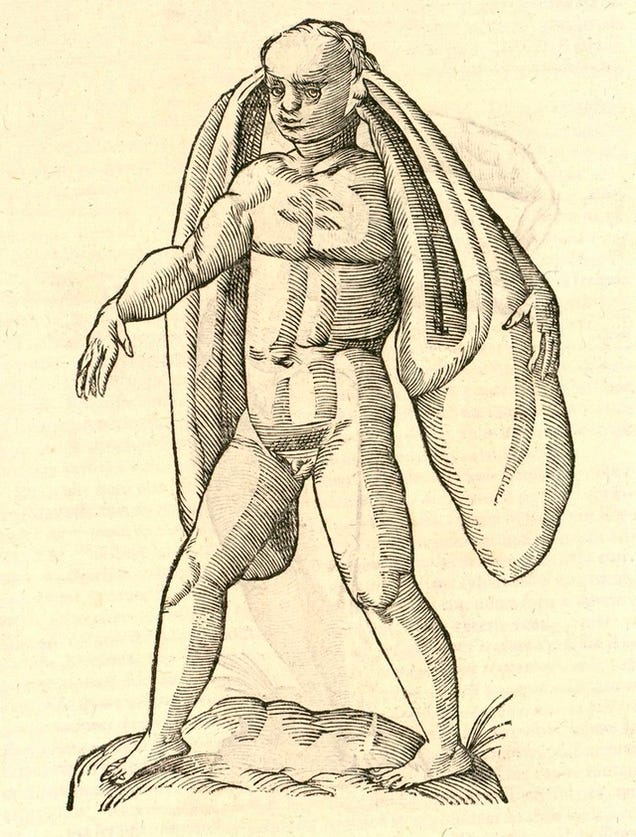 Pandi - Greek mythical tribe with gigantic ears, eight fingers and toes, and white hair which turns black with age.
  Panotii - A mythical peoples of Greek origin whose ears were so large that they forsake clothing, and could possibly fly with them.
 Pantheon - Heraldic beast with the body of a hind (black, dark blue, or red in color) spotted with mullets (straight pointed stars) or estoilles (wavy pointed stars), a fox's bushy tail, and cloven hooves.
 Parandrus - An ox-sized creature with shaggy, bear-like hair, deer's legs with cloven hooves, and a stag's head with branching antlers. It has the ability to change the color of it's skin like a chameleon. Also called Parander, Tarandos, Tarandrus, and Tharandus.
 Pard - Extremely fast feline creatures with spotted coats believed to mate with lions to produce leopards.
 Polypus - Meaning "many-footed," this term is used to name giant lobsters and depictions of eight-legged, giant fish.
 Pristers - Also called Physeter or Pristis, a whale sized creature with a mammalian face, horse's mane, and two blow holes which it uses to spout water at ships and sink them.
 Pygmies - A tribe of goat riding, Greek humanoids pygme ("length of the forearm") tall, locked in battle with cranes.
 Questing Beast - Chimeric monster of Arthurian legend that has the head and neck of a snake, body of a leopard, hindlegs of a lion, and the feet of a hart. Also known as the Beast Glatisant or Barking Beast.
 Quinotaur - Sea creature from Frankish myth that resembles a hippocampus, but with the foreparts of a bull instead of horse, and an addition of three more horns forming a trident formation in the middle of the forehead.
 Rockas - Gigantic rays known to rescue swimmers harassed by Sea-Dog-Fish.
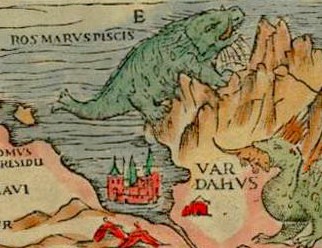 Rosmarus - An amphibous "sea-elephant" that is more like a horse or dog combined with a walrus. It is a quadruped creature with clawed limbs, tusks, and a fish's tail.
 Satyrus - Also known as callitrix or cericopithicus. An ape species which bears twins, one of which the parent hates and the other that the parent loves.
 Scitalis - Also known as Scytalis or Scytale, this serpent has hypnotic markings on it's back which allows it to awe viewers, thus allowing it to strike. It is sometimes depicted with two front legs and its body heat is so great that it sheds skin even in winter.
 Sciritae - Greek mythical tribe from India who have snake-like nostrils instead of a nose, and bandy, serpentine legs. Also called Syrictae, Scritai or Skiritai.
 Sea-Bee - A heraldic beast composed of a bee with a fish tail.
 Sea Bishop or Sea Monk - A fish that looks like a monk.
 Sea Goat - Heraldic beast with the head and forelegs of a goat and a fish's tail.
 Sea Rhinoceros - Fish-like creature with the head of a rhinoceros and a spotted pattern on it's hide.
 Sea Wolf - Heraldic beast with the head and forelegs of a wolf and a fish's tail.
 Sea Wyvern - Heraldic wyvern with a fish's tail in place of a wyvern's barbed tail.
 Seps - Serpent with pointed ears and poison that liquifies its prey. Sometimes depicted with two or four legs.
 Serpopard - Chimeric creature with the body of a leopard or lion and the head and neck of a snake.
 Sha - Also called Set Animal, Typhonian Animal, and Typhonic Beast. This chimera consists of an aardvark's head, a jackal's body and front lets, a donkey's hindlimbs, and a forked reptilian tail that has triangular points.
 Sirrush - Messopotamian and Babylonian scaly dragon with hind legs resembling the talons of an eagle, lion forelegs, a long tail, a horned head, a snake-like tongue, and a crest. Also called Mushassu, Musussu, Mushhush, and Sirrusu.
  Skiapodes - Also known as Monopods, Sciapods, and Skiapods. A mythical race of creatures with one large foot on one leg that used their large foot to as a sun shade or rain shield. They were beleived to hail from Eithiopia or India.
 Springhval - Norwegian name for a whale fish with a sword-like dorsal fin, arm-like flippers, and a boar's snout and tusks that is a very fast swimmer. Also called Orca.
 Syrbotae - Twelve foot tall giant peoples hailing from Africa in Greek mythology.
 Telchines - Also spelled Telkhines. Malignant Greek magician creatures found on the islands of Keos and Rhodes with flippers for hands and dog's heads who were great metal-workers, having forged Chronos' Sickle and Poseidon's Trident. Their magical abilities include shapeshifting, being able to control weather, bringing about hail, snow or rain, fouling water, producing poisonous substances, causing crops to whither, and a hypnotic gaze.
 Theow - Wolf-like heraldic beast with cloven hooves, and a bovine muzzle and tail.
 Wiedergänger - Germanic revenant which may cause mischief or desire to avenge an injustice from when they were alive. May be related to Norse Draugr, headless riders, and vampires.
 Yale - Also known as Centicore, Eale, or Jall. A black, bull-like beast with a goat's head, the tusks of a boar and the tail of an elephant, notable for having two horns (which may appear straight or curved) that can swivel, with one generally kept pointing backwards so that it can bring that horn to bear if the other should be damaged. In heraldic depictions, it often has a goat's body and a pattern of multi-colored spots. There are also some additional variants, such as an antelope's body, horse's body, ears, mouth, and/or tail, tawny fur, a tufted lion's tail, a bear's snout, lion's face, bear's face, cloven feet, or pawed feet. It is the enemy of the basilisk.
 Yppotryll - Heraldic beast with the body and humps of a camel, tusked boar's head, cloven hooves, and a serpent's tail. Also called Hippotryll or Ypotryll.
  Zaratan - Likely just the Middle Eastern name of the Aspidochelone, this creature, an island turtle, appears in The Book of Imaginary Beings and is likely the name for the island whale encountered in Sinbad the Sailor's First Voyage.
 Ziphius - Large fish- or whale-like sea monster with a sword-like dorsal fin which it uses to attack ships, and an owl's face. It feeds primarily on black seals.
*The Tolkienesque Orc appears to derive from the words orcþyrs or orcneas, related to the term orco (ogre), ultimately believed to be derived from the Roman Orcus. This type of "Orc" also appears in Orlando Furioso, as a blind, cannibalistic giant that cannot be killed.

